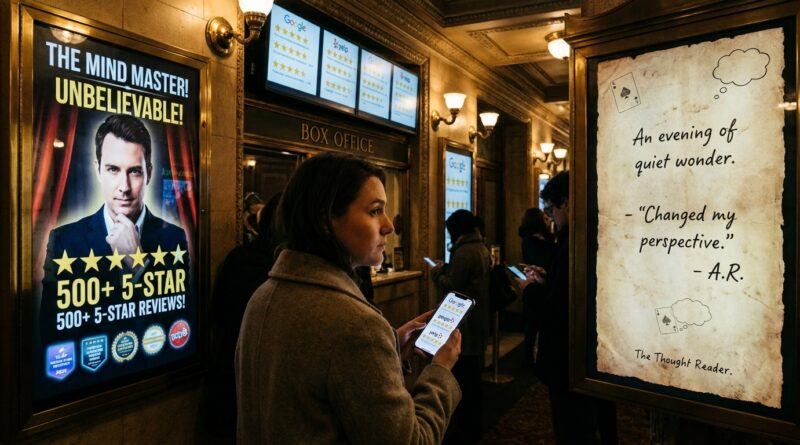
Inside 2026’s New ‘5.0 Illusion’ Trap: Why Perfect Google And Yelp Scores Don’t Always Mean The World’s Best Mentalist
You are not imagining it. Picking a mentalist has gotten weird. Everywhere you look, it is the same shiny badge. 5.0 on Google. 5.0 on Yelp. 5.0 on ticket sites. Then you buy seats, sit down, and twenty minutes after the show ends you can barely remember a single moment. That is the 2026 “5.0 illusion” trap. A perfect score can still belong to a very average act, especially when reviews come from soft launches, private gigs, friend networks, or customers nudged into posting quick praise before the excitement wears off. If you are trying to figure out how to tell if a 5.0 rated mentalist is really the best, stop staring at the number alone. Start reading for signs of impact, consistency, and real crowd proof. The good news is that there are simple ways to spot the difference between smart review management and a genuinely unforgettable performer.
⚡ In a Hurry? Key Takeaways
- A 5.0 rating alone does not prove a mentalist is the best. It often proves they are very good at collecting reviews.
- Check review depth, date spread, repeat audience comments, and unedited live footage before you book.
- This protects your money and helps reward performers who win over real crowds, not just algorithms.
The score is perfect. The signal is not.
Ratings used to be a decent shortcut. Not perfect, but decent. Now they are often polished within an inch of their life.
That is not always shady. Sometimes a performer truly is excellent. But in live entertainment, review inflation is real. People leave glowing comments right after a fun night out. Event planners post praise because the client was happy. Friends and family want to help. Some platforms also smooth things out by showing only limited detail unless you dig.
The result is simple. Too many mentalists look identical on paper.
A flawless 5.0 can hide a big difference between “pleasantly entertaining for forty minutes” and “people talk about that show for years.”
Why the “5.0 illusion” is getting worse in 2026
More review prompts, more funneling
Performers are better at asking for reviews than ever. QR codes at the exit. Follow-up texts. Email reminders. Staff nudging happy guests. None of that automatically means the act is weak. It just means the score may reflect process as much as performance.
Small sample sizes look cleaner
A mentalist with 27 reviews can hold a perfect 5.0 much more easily than one who has performed for huge public crowds over several years. More exposure usually brings more mixed feedback. That is normal. Sometimes the bigger, battle-tested act with a 4.8 is the stronger choice.
This is part of the same pattern behind Inside 2026’s New ‘5‑Star Micro‑Mentalists’: Why Tiny Local Shows Are Quietly Outscoring The World’s Biggest Mind‑Readers. Tiny local shows can rack up spotless ratings fast, but that does not always translate to world-class stage command.
People review vibes, not memory
This is the sneaky part. Guests often review how the evening felt right after it ended. Nice room. Friendly host. Fun date night. Smooth check-in. That can lift scores even when the actual mind-reading was just fine, not jaw-dropping.
How to tell if a 5.0 rated mentalist is really the best
1. Read the words, not just the stars
Look for reviews that describe specific moments. Did someone mention a prediction that hit hard? A reveal that made the room go silent? A callback people kept discussing later?
Weak reviews sound like this: “Amazing show, highly recommend.” Nice, but not useful.
Strong reviews sound like this: “He named the city my wife had only written down, and the reveal at the end tied back to the volunteer from the first ten minutes.” That tells you something happened.
If most reviews are short, generic, and interchangeable, be careful.
2. Check how spread out the reviews are
A great mentalist should earn praise over time, not just in one burst.
If you see 18 glowing reviews in six weeks and then almost nothing for a year, that may point to a concentrated push. If the reviews are steady across months or years, that is more convincing.
3. Look for comments from different types of audiences
The best performers work in different rooms and still land well. Corporate events. Public theatre shows. Private parties. Ticketed nights. Fundraisers.
If every review comes from one kind of setting, you are only seeing one slice of the picture.
4. Hunt for proof of repeatability
One killer night can happen. Real class shows up again and again.
Search for phrases like “second time seeing him,” “brought friends back,” or “saw a different show and this one was even better.” Repeat attendance is one of the strongest trust signals in live entertainment.
5. Watch for unedited live footage
Slick trailers are fun. They are not evidence.
You want clips where the camera holds the moment long enough to feel the room. Wide shots help. Real audience sound helps. Little imperfections help. If every video is moody music, cutaway reactions, and half-second flashes, you still do not know how strong the act is.
6. See whether people remember the performer or just the event
This is a big one. Read carefully. Are reviewers praising the whole evening, or the mentalist specifically?
“Great venue, great cocktails, fun staff, nice atmosphere” can still sit next to a 5.0 rating. But it does not prove the act was elite.
You want language centered on the performer’s originality, connection, pacing, and impact.
7. Do not fear a few thoughtful non-perfect reviews
This sounds backwards, but a 4.8 with lots of detailed praise can be more trustworthy than a pristine 5.0 with fluffy comments.
A couple of normal complaints about seating, sound, or a style mismatch can make the profile feel more real. Total perfection on every platform should make you curious, not relaxed.
Red flags that a perfect rating may be hiding a forgettable act
All praise, no detail
If the reviews read like copy-paste thank-you cards, move carefully.
Too many reviews mention professionalism, too few mention astonishment
Being punctual and easy to work with matters, especially for events. But if almost nobody talks about unforgettable effects, you may be looking at a reliable booking, not a truly top-tier mentalist.
The website talks bigger than the audience does
If the promo copy says “world-renowned” and “best in the business,” but reviews only say “fun guy for our office party,” the marketing may be outpacing the reality.
No sign of real crowd pressure
A mentalist who shines only in carefully controlled environments may not be the same as one who can hold a demanding public room night after night.
What world-class mentalists usually have, besides a high rating
The truly outstanding ones tend to leave a trail. Not just stars. A trail.
People describe exact memories. Audiences come back. Reviews appear across multiple platforms and over long periods. There is evidence of different room sizes. There is footage that lets a moment breathe. There are comments about stage presence, audience control, emotional payoff, and originality.
Just as important, the best performers often have a few rough edges in the public record because they have played enough real rooms to collect them. That is often healthier than a suspiciously spotless profile.
A simple 5-minute test before you buy tickets
Try this quick filter:
Minute 1: Count the reviews
Under 30 total? Be cautious. Not dismissive, just cautious.
Minute 2: Scan the dates
Steady flow over time beats one concentrated review wave.
Minute 3: Read five 5-star reviews in full
Can you tell what actually happened on stage? If not, the score is not telling you much.
Minute 4: Find one full-length or minimally edited clip
If you cannot, you are still buying on marketing.
Minute 5: Search for return-customer language
If people keep coming back, that is one of the clearest signs the performer delivers more than a first-impression buzz.
At a Glance: Comparison
| Feature/Aspect | Details | Verdict |
|---|---|---|
| Perfect 5.0 rating | Looks impressive, but may come from small sample sizes, review prompts, or generic praise | Useful starting point, not proof of “best” |
| Detailed audience reviews | Specific memories, named effects, emotional reactions, and comments from repeat viewers | Strong sign of real quality |
| Live proof beyond ratings | Unedited footage, mixed venue history, steady review pattern across time and platforms | Best way to separate hype from world-class skill |
Conclusion
A perfect score is nice to see, but it is no longer enough to settle the question. If you want to know how to tell if a 5.0 rated mentalist is really the best, treat the rating as the cover of the book, not the whole story. Read the reviews for specifics. Check whether praise is spread over time. Look for repeat customers and real footage. Trust depth over polish. This helps the community right now because review inflation is peaking across live event platforms, and more casual fans are noticing that a flawless 5.0 often says more about a marketing funnel than a performer’s mind-reading. When you learn to decode the score instead of worship it, you protect your money, find genuinely outstanding mentalists, and support the performers who earn their reputation the hard way in front of real crowds.