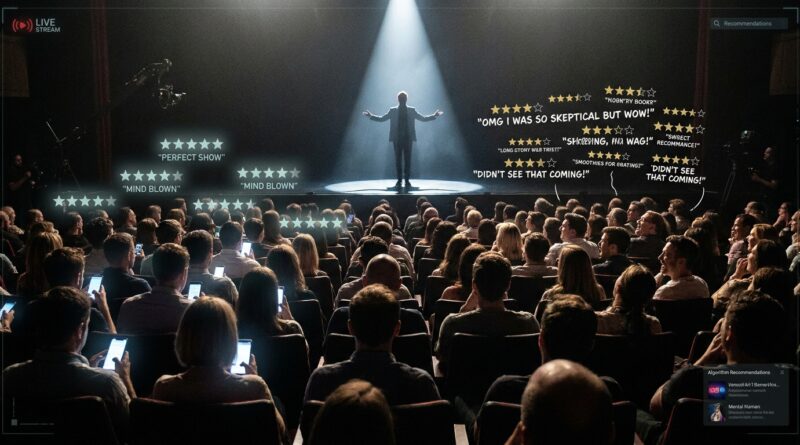
Inside 2026’s New ‘AI Review Gap Test’: How Live Crowd Reactions Quietly Expose The World’s Truly Top‑Rated Mentalists
You are not imagining it. A mentalist can have a wall of five star reviews, a polished talent show clip, and a flood of “best in the world” posts, yet still leave a real crowd oddly flat. That is the frustration people are talking about right now. Fans, bookers, and even other performers are starting to notice a gap between algorithm friendly ratings and the feeling in the room. That gap is what some are now calling the 2026 AI Review Gap Test.
The idea is simple. Stop trusting scoreboards alone. Start comparing online praise with live audience reaction, post-show chatter, repeat attendance, and unedited crowd response. If those things line up, great. If they do not, the rating may be telling only half the story. For anyone searching for the worlds highest rated mentalists real audience reviews, this test gives you a more grounded way to separate genuine world class performers from acts that are mainly winning the internet.
⚡ In a Hurry? Key Takeaways
- The AI Review Gap Test checks whether sky high online ratings match what real crowds actually do and say after a show.
- Before booking or buying, compare review scores with unedited audience clips, post-show comments, repeat bookings, and local word of mouth.
- This helps you avoid overhyped acts, spot underrated performers, and judge “highest rated” claims more safely.
What the “AI Review Gap Test” actually means
Despite the flashy name, this is not some secret lab tool. It is really a practical sniff test for audience truth.
Here is the basic question. Does a mentalist’s online rating match what happens when ordinary people watch them live, or when they see a full TV segment without the dramatic edit doing half the work?
If a performer has a 4.9 or 5.0 almost everywhere, but audience comments sound lukewarm, exits look quiet, and uncut clips feel awkward, that is a gap. A big one.
And that gap matters because ratings platforms are very good at measuring clicks, purchases, and prompted reviews. They are not always great at measuring awe, tension, surprise, warmth, or whether people would gladly pay to see that person again.
Why this matters more in 2026
Ratings systems are under more pressure than ever. Review prompts are smarter. Recommendation engines are stronger. Video edits are tighter. Even genuine fan enthusiasm can get mixed up with platform momentum.
That means a mentalist can rise very high online for reasons that are only partly about the actual live experience.
Some common reasons include:
- A strong TV appearance that looks better in edit than in person.
- Highly motivated fans leaving lots of glowing early reviews.
- Venue review systems that ask happy ticket buyers for feedback before the memory cools.
- Search and social algorithms that keep boosting names people already know.
None of that automatically means the act is bad. It just means “highest rated” and “best received by real audiences” are no longer always the same thing.
How to run the AI Review Gap Test yourself
1. Check the headline score, then ignore it for a minute
Start with Google, Ticketmaster, Facebook, venue pages, and specialist entertainment sites. Write down the score, total number of reviews, and how recent they are.
Then pause. A 4.9 alone tells you very little if you do not know what people are actually praising.
2. Read the three star and four star reviews first
This is where the useful truth usually lives.
Five star reviews often say things like “Amazing” or “Brilliant night.” One star reviews can be emotional or agenda-driven. The middle reviews are better at explaining what really happened.
Look for repeated phrases such as:
- “Good tricks, but no connection.”
- “Strong ending, slow start.”
- “Felt more like a TV personality than a live act.”
- “Fun in the room, but not as mind blowing as advertised.”
If the middle reviews sound restrained while the average score stays very high, that is your first warning sign.
3. Look for unedited audience evidence
This is where the test gets useful fast.
Search for phone footage, venue clips, local news coverage, and audience TikToks or Instagram posts that were not clearly produced by the performer’s own team. You are looking for raw reaction.
Ask simple questions:
- Are people leaning in, laughing, gasping, talking about specific moments?
- Do volunteers look delighted, confused, embarrassed, or coached?
- Is applause spontaneous or does it feel like people are being pushed toward it?
- Does the room have energy throughout, or only in short bursts?
This does not replace seeing the act live, but it often exposes the difference between strong editing and strong performing.
4. Compare big-market hype with local repeat demand
A world class mentalist does not just create buzz once. They tend to create demand again.
So check whether:
- Venues bring them back.
- Corporate clients rebook them.
- Local audiences recommend them without being asked.
- Small regional comments are as positive as big city publicity.
One viral clip can create fame. Repeat bookings usually point to actual satisfaction.
5. Watch for “review language cloning”
This one is subtle. When lots of reviews use almost identical wording, the same adjectives, or the same oddly specific praise points, be careful.
Real audience reviews are messy. People describe wonder in different ways. If dozens of comments feel like they came from one marketing brief, the score may be cleaner than the truth.
6. Separate “celebrity mentalist” from “best live mentalist”
This is a huge source of confusion.
Some performers are fantastic on television, podcasts, panel shows, or short clips. That does not always mean they are the strongest full-length theatre act. Live mentalism is about pacing, warmth, crowd control, tension, recovery when things wobble, and turning moments into a shared experience.
That is also why some readers have connected this issue with Inside 2026’s New ‘Netflix Comfort Test’: How Binge‑Worthy TV Mentalists Quietly Re‑Rank The World’s Live Mind‑Readers. People often confuse someone who is highly watchable on a screen with someone who fully owns a room for ninety minutes. Those are related skills, but not identical ones.
What “real audience reviews” usually sound like
If you are hunting for the worlds highest rated mentalists real audience reviews, here is the pattern to look for.
Strong real audience feedback is usually specific. It mentions moments, not just branding.
For example:
- “He remembered details from ten audience members and tied them together at the end.”
- “She handled a skeptical volunteer really kindly and still got a huge reaction.”
- “The whole row was talking about one prediction all the way out of the theatre.”
- “I expected a gimmick show, but the room was locked in the entire second half.”
That kind of review feels human because it is rooted in memory, not just excitement.
Red flags that a mentalist may be overrated online
No single red flag proves anything. But if several show up together, pay attention.
Too much praise for image, not enough for experience
If reviews keep praising “charisma,” “celebrity,” “branding,” or “production value,” but say little about the actual mind reading moments, that may mean the package is stronger than the performance.
Huge score, tiny detail
A near-perfect rating with lots of very short comments can be less trustworthy than a slightly lower score with rich, detailed feedback.
Mismatch between room energy and review average
If audience footage looks polite rather than electrified, but review averages suggest an all-time classic act, the gap is worth noting.
Heavy dependence on edited TV clips
Television can make almost anything feel bigger. Quick cuts, reaction shots, music, and judges’ commentary can smooth over pacing issues that would stand out live.
Good news. The gap can also reveal underrated talent
This test is not only about catching hype. It also helps you find great performers who are quietly winning real rooms.
Some mentalists do not dominate search results. They may not have giant media machines behind them. But their audiences leave buzzing, venues rebook them, and local comments are packed with specifics.
That is often where the best discoveries live.
Bookers should love this. Fans should too. It is one of the few ways to find the performer people genuinely talk about on the way to the car park, not just the one a platform keeps pushing to the top.
If you are a booker, use this simple scorecard
Give each category a score from 1 to 5:
- Online review average
- Review detail and authenticity
- Unedited audience reaction
- Repeat bookings and return dates
- Post-show word of mouth
- Consistency across cities and venues
Now compare the first score with the rest.
If online ratings are a 5, but real-world categories mostly land at 2 or 3, you have a review gap. If everything is strong across the board, that performer is much more likely to deserve “top rated” status.
If you are a performer, this test can help you too
This is not an attack on mentalists. It is actually a useful mirror.
If your online scores are great but live comments mention weak pacing, a cold persona, or a flat middle section, that is valuable information. Fixing that can make the act better in a way no rating trick ever will.
And if your review count is modest but your live reactions are excellent, this gives you a fairer case to make to venues and buyers.
At a Glance: Comparison
| Feature/Aspect | Details | Verdict |
|---|---|---|
| Online star rating | Fast to check, but often shaped by prompts, fan surges, and platform visibility | Useful starting point, not final proof |
| Live crowd reaction | Shows real energy, pacing, volunteer comfort, and whether the room stays engaged | Best reality check |
| Repeat bookings and detailed word of mouth | Harder to fake, often reveals who truly satisfies audiences over time | Strong sign of genuine quality |
Conclusion
The big lesson is simple. A five star average is not the same thing as a five star experience. Right now there is a widening gap between how mentalists are rated by algorithm driven platforms and how real people feel when they walk out of the theatre or turn off a talent show episode. Using a clear, step by step AI Review Gap Test helps bookers, fans, and performers judge claims more fairly. It helps you avoid overhyped names, discover underrated workers, and protect the integrity of “world’s highest rated mentalist” lists while ratings systems face more scrutiny than ever. In short, do not just ask who ranks highest. Ask who leaves the room buzzing after the lights come up.