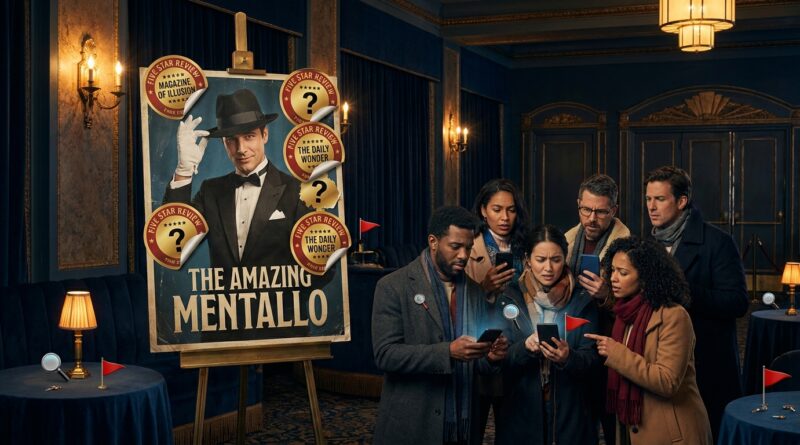
Inside 2026’s New ‘Fake Five-Star Test’: How Dubious Reviews Quietly Re-Rank The World’s Highest-Rated Mentalists
It is maddening to pay for a show based on glowing five-star praise, then walk out wondering if you saw the same performer everyone else reviewed. That frustration is spreading fast around fake mentalist reviews 2026. Fans are spotting suspicious patterns. Tiny review accounts with no history. Quotes from “major publications” that seem impossible to verify. Social profiles that look more like cheer squads than real audience members. The result is a quiet re-ranking of who gets called the world’s highest-rated mentalists, and not always for the right reasons. A performer can look unbeatable online while more skilled rivals get buried simply because they are not gaming the system. The good news is you do not need forensic software to spot most of this. You just need a simple stress test. Check where the reviews came from, whether the praise sounds human, and whether real ticket buyers describe the same experience over time.
⚡ In a Hurry? Key Takeaways
- Some “highest-rated” mentalists in 2026 appear boosted by thin, hard-to-verify five-star reviews rather than consistent audience love.
- Stress test reviews by checking reviewer history, date clusters, repeated wording, and whether praise matches detailed ticket-buyer feedback.
- Doing this protects your money, helps truly elite performers stand out, and keeps rankings more honest.
What the new “fake five-star test” really means
This is not one official industry exam. It is the practical test fans are now applying on their own.
When a mentalist claims to be “the world’s highest rated,” people are starting to ask a basic question. Rated by whom?
That matters because ratings can be padded in ways that look convincing at a glance. A profile may have dozens of perfect scores, but if those reviews arrived in a burst, came from blank accounts, or repeat the same phrases, trust drops fast.
The backlash is fresh because fans are comparing star averages with what paying audiences actually report after the show. In some cases, the gap is hard to ignore. The rating says life-changing. The audience says decent, short, and overhyped.
Why this is hitting mentalism especially hard
Mentalism sells mystery. That can make marketing blur into myth pretty easily.
A strong performer should absolutely market well. No issue there. The problem starts when promotion crosses into invented authority. A made-up publication mention. A quote that cannot be found anywhere. Social accounts that exist mainly to praise one person.
Because many buyers only see the polished top layer, these signals can nudge rankings, booking decisions, and media coverage. One performer gets labeled elite. Another, possibly better live, gets overlooked.
That is also why broader ranking debates are changing. It is no longer enough to ask who gets the loudest online applause. People also want to know who holds attention in the room. That is part of why pieces like Inside 2026’s New ‘Immersion Test’: How Full-Sensory Shows Quietly Re-Rank The World’s Highest-Rated Mentalists are landing with readers. Fans want proof that goes beyond a five-star tile.
The biggest red flags in fake mentalist reviews 2026
1. Review bursts that appear overnight
If a performer gets 25 glowing reviews within a couple of days, then nothing for weeks, look closer. Real audience feedback is usually more uneven. Big spikes can happen after a festival or TV spot, sure. But if the wording also feels repetitive, be cautious.
2. Reviewer accounts with no real footprint
Click into a few profiles. If they reviewed only one performer, have no photo, no other activity, and no local detail, that is a warning sign. One or two odd reviews mean little. A pattern means something.
3. Praise that sounds like ad copy
Real people tend to be messy. They mention the venue, the crowd, a favorite bit, maybe even one thing they did not love. Fake praise is often too polished. “Absolutely mesmerizing, unforgettable, world-class genius” starts to read like a press release when repeated enough.
4. Publications that are hard to verify
If a site claims “featured in” or “praised by” major outlets, try to find the original mention. Not a cropped logo. Not a quote image. The actual article, clip, or listing. If you cannot find it, treat that claim as unproven.
5. Social accounts that only post one person
Fan pages are normal. Sock-puppet support networks are not. If several accounts post the same clips, use the same language, and engage only with one mentalist, that can be manufactured buzz.
How to stress test a mentalist’s reviews in five minutes
You do not need to become a detective. Just run this quick checklist.
Check more than one platform
Do not rely on a single review source. Compare Google, ticketing platforms, Reddit discussions, YouTube comments, and venue feedback if available. Consistency matters more than one shiny score.
Read the three-star and four-star reviews
These are often the most useful. They tend to sound more real and give detail. If the middle reviews still praise the performer’s skill, pacing, and crowd connection, that is a good sign.
Look for specifics
Did reviewers mention audience interaction, originality, venue fit, or how the show felt from the seats? Specificity is hard to fake at scale.
Compare claims with footage
If someone is billed as the best in the world, clips should at least support the basics. You are not judging the entire act from a teaser. You are checking whether the confidence of the marketing matches visible audience response.
See whether the reviews age well
A true top-tier performer tends to earn praise over time, not just in one concentrated wave. Longevity counts.
What honest excellence looks like
Real greatness is usually boring in the best possible way. It is steady. The reviews come from different places. The language varies. The praise lines up with live reactions and repeat bookings.
You also see a richer picture. Not just “mind blown,” but comments about warmth, pacing, originality, audience care, and whether people would pay to see the show again.
That is important because the best mentalists are not just collecting stars. They are creating a full experience. As readers have noticed in the growing debate around immersive performance, the performers rising fastest now often give people something deeper than a social clip moment. They hold the room.
Why inflated ratings distort the whole market
This is bigger than one disappointing night out.
When weak or questionable reviews push a performer up the ladder, venues may book the wrong act. Journalists may repeat shaky claims. Fans may spend premium prices on a show that does not deliver. Meanwhile, genuinely brilliant performers can get pushed down because they are competing against a polished fiction.
That is why “highest rated” lists need more than star counts. They need context. Review quality. Source diversity. Consistency over time. Real audience detail.
What we should reward instead
We should reward performers whose reputation survives scrutiny.
That means credible reviews from real people. Verifiable press. Repeat venue demand. Strong word of mouth. And most of all, a live experience that matches the promise.
Not every five-star review is fake. Far from it. Plenty are earned. The point is to stop treating a perfect score as automatic proof of greatness.
At a Glance: Comparison
| Feature/Aspect | Details | Verdict |
|---|---|---|
| Review pattern | Steady feedback over months or years is more trustworthy than sudden five-star bursts from low-history accounts. | Steady beats spiky |
| Praise quality | Detailed comments about the actual show feel more reliable than generic lines that read like marketing copy. | Specific beats vague |
| Media and social proof | Verifiable articles, real audience chatter, and normal fan activity carry more weight than logo walls and suspicious support accounts. | Proof beats polish |
Conclusion
Fans are right to be skeptical right now. There is real backlash building around mentalists whose star ratings do not line up with what paying audiences actually get, including questions about invented publications and self-written praise. That tension shapes who lands on “world’s highest rated” lists, who gets booked, and who gets unfairly ignored. The fix is not cynicism. It is a better filter. If our community keeps stress testing reviews with a little common sense, we protect fans from bad bets, reward the truly elite performers, and keep rankings honest at a time when trust in ratings is wobbling.