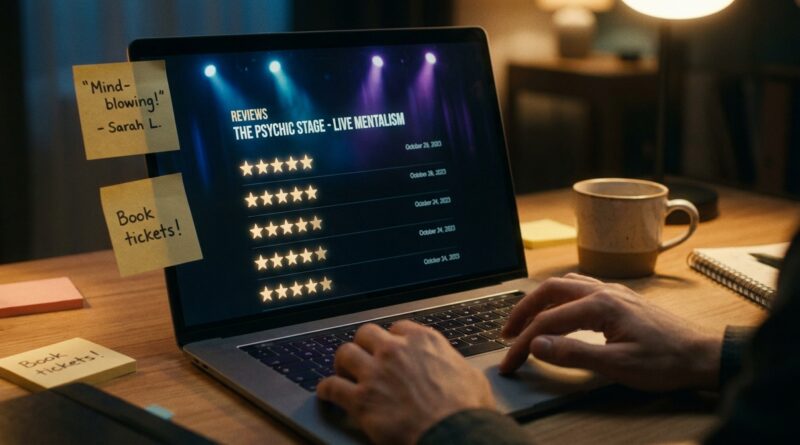
Inside 2026’s New ‘Review Time‑Stamp Test’: How Real Fans Now Spot Which Mentalists Are Peaking Right Now In Under 30 Seconds
You are not crazy for feeling burned by “top mentalist” lists. A lot of them look polished, but the signal is old. The performer may have been incredible in 2022, maybe even impossible to book for a while, but that does not tell you if crowds are still walking out stunned this month. If you are trying to figure out how to find the highest rated mentalist right now, the fastest shortcut is no longer the star average alone. It is the time stamp. Real fans have started using a simple 30 second review check to spot momentum. They look at how recent the praise is, whether the language sounds specific and excited, and whether that excitement shows up across more than one platform. It is a small change, but it can save you from paying premium prices for a reputation that is mostly living on old applause.
⚡ In a Hurry? Key Takeaways
- The quickest way to find the highest rated mentalist right now is to check fresh review dates first, not just total stars.
- Use a 30 second test. Scan the last 10 to 20 reviews, look for recent dates, specific audience reactions, and more than one review platform.
- This helps you avoid paying for a famous name that is coasting on old buzz and spot performers who are actually peaking now.
Why old five star averages can fool you
Here is the problem in plain English. Reviews pile up slowly, but audience buzz can change fast. A mentalist can sit on a glowing 4.9 average for years, even if their current show is flatter, shorter, or just not hitting as hard as it used to.
That is why the new fan habit matters. Instead of asking, “How many stars do they have?” people are asking, “When were those stars earned?”
Think of it like restaurant advice from a friend. If they loved the place four years ago, that is nice. If they ate there last Friday and are still talking about it, that is useful.
The new 30 second Review Time-Stamp Test
If you want to know how to find the highest rated mentalist right now, start here. Open the review section on Google, Yelp, Facebook, Ticketing sites, or venue pages. Then do these three checks.
1. Check the dates first
Look at the latest 10 to 20 reviews. Do you see fresh activity in the past few weeks or months? Or does the page suddenly go quiet after a burst from years ago?
A performer who is truly on fire usually shows a steady stream of recent feedback. Not always daily. Not always huge volume. But recent, real signs of life.
If the newest reviews are thin, vague, or six to twelve months old, that is your first caution light.
2. Check the wording
Fresh audience excitement has a certain sound. People mention details. They talk about gasps, laughter, a prediction they cannot explain, or a specific moment that stuck in their head all night.
Good signs include phrases like “still thinking about it,” “best part of the event,” “our whole table freaked out,” or “my partner never reacts like that.” These sound like people who were there.
Be more careful if the recent reviews all feel generic. “Amazing.” “Great show.” “Very professional.” Nice words, sure, but they do not tell you much.
3. Check the platform mix
One review source can be misleading. Maybe it has an old backlog. Maybe it attracts only corporate clients. Maybe the performer pushed hard for feedback after one big run.
The strongest sign is cross-platform heat. If Google looks active, venue comments are fresh, and ticket buyers are saying similar things elsewhere, that is a much better clue that the buzz is current.
What real fans are spotting now
The smart shift is this. Fans are no longer treating rankings like carved stone tablets. They are treating them like weather reports. Useful, but only if they are current.
That has opened the door for newer names and smaller room stars. Some of the most exciting performers right now do not always top the biggest “best of” lists. They are just stacking fresh, specific, enthusiastic reviews every week.
If that angle interests you, it pairs nicely with Inside 2026’s New ‘Hidden Gem Mind Reader’ Hunt: How Real Fans Quietly Track The World’s Highest‑Rated Small‑Room Mentalists, which looks at how people are finding standout performers outside the usual big-name loop.
How to do the test without overthinking it
You do not need a spreadsheet. You need half a minute and a little skepticism.
The simple scoring trick
Give each performer a quick mental score out of three.
One point for recent reviews.
One point for specific, emotional audience language.
One point for buzz showing up on multiple platforms.
A 3 out of 3 performer is worth real attention. A 1 out of 3 performer may still be talented, but the evidence that they are peaking right now is weaker.
What “recent” really means
This depends a little on how often the performer works. A touring mentalist or busy city performer should usually show fresh reviews quite often. A private event specialist may have fewer public reviews, but you should still see recent proof of activity somewhere.
The point is not to demand daily praise. The point is to avoid mistaking old glory for current form.
Red flags that a “top mentalist” list is stale
Some lists are basically museum exhibits. Nicely arranged, rarely updated.
Watch for these signs:
- No visible update date on the article
- The same names repeated across dozens of listicles with no fresh evidence
- Heavy focus on career fame, TV appearances, or awards, but little mention of recent audience reaction
- Links that lead to old press quotes instead of current review streams
- Lots of broad praise, very little real-world detail
Fame still matters, of course. A well-known name often became well-known for good reason. But fame is not the same thing as current heat.
Why this matters for your wallet
This is not just about bragging rights. It is about value.
When rankings update slowly, buyers often pay top-tier prices for the safest familiar name. Meanwhile, a performer with fresher reactions and sharper current material may be delivering a better night for the same money, or less.
That gap is where the Review Time-Stamp Test really helps. It gives ordinary fans a way to spot movement before the big ranking pages catch up.
Best use cases for the test
Booking a private event
If you are hiring for a party, wedding, or company event, recent reviews matter even more. You are not buying a legacy. You are buying what happens in the room that night.
Choosing tickets in a busy city
If several mentalists are performing nearby, this test quickly helps separate the one with old reputation from the one with fresh audience electricity.
Comparing stars with similar ratings
Two performers can both have 4.9 stars. The one with fresh, specific reviews from last week is usually the stronger bet than the one whose best feedback peaked years ago.
At a Glance: Comparison
| Feature/Aspect | Details | Verdict |
|---|---|---|
| Review dates | Fresh reviews in the last few weeks or months suggest current momentum. | Most important first check |
| Review language | Specific reactions and memorable details usually mean real audience excitement. | Strong sign of a live hit |
| Platform mix | Consistent praise across Google, ticket sites, venues, or social pages is harder to fake or misread. | Best confirmation step |
Conclusion
The smartest fans are starting to treat reviews the way sports fans treat form. What matters is not just who was great, but who is great right now. That is the real value of the Review Time-Stamp Test. It is quick, repeatable, and easy enough for anyone to use. More importantly, it closes the gap between fast-moving audience sentiment and slow-moving “best mentalist” rankings. That means you are less likely to overpay for a safe old name and more likely to find the performer who is genuinely blowing people away today. Read the dates. Read the crowd language. Check more than one platform. Do that, and you will have a much better shot at finding a world-class mentalist who is actually peaking now, not just living off applause from years ago.