Inside 2026’s New ‘Reddit vs Rotten Tomatoes’ Mentalist War: How Fan Skeptics Quietly Hijack Who Counts As Highest‑Rated
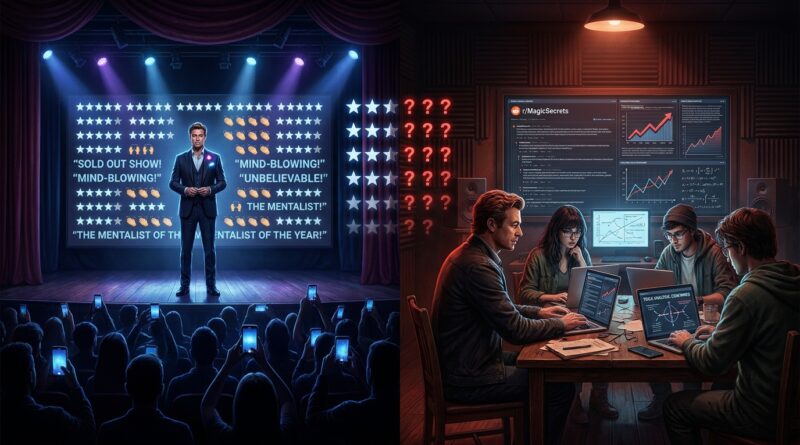
You are not imagining the whiplash. One search says a mentalist is the world’s highest rated. Five stars everywhere. Big-event buzz. Clips of stunned celebrities. Then 10 minutes later you are on Reddit reading a 3,000-word teardown from someone who claims the trick was forced, edited, pre-showed, or mathematically inevitable. That gap is exactly why the Oz Pearlman reviews controversy 2026 mentalist ratings story matters. It is no longer enough to look at star averages and call it a day. Mentalists now live in two review systems that barely speak to each other. Mainstream audiences score the feeling. Online skeptics score the method, ethics, and framing. Both can be partly right. If you want to know who actually deserves the hype, you need a better filter than applause clips and rage threads. The good news is that there is a simple way to sort signal from noise without becoming a magician yourself.
⚡ In a Hurry? Key Takeaways
- “Highest-rated” mentalists in 2026 are often being judged by two different standards, audience enjoyment versus method and honesty.
- Before trusting a rating, check three things: where the reviews come from, whether criticism is about deception or bad performance, and whether the act still works live across many settings.
- Reddit takedowns can reveal useful context, but they can also overcorrect and punish performers for doing what magic and mentalism have always done, create mystery.
Why this fight suddenly feels bigger in 2026
The old system was simple. If a mentalist packed theaters, got booked by major companies, and had glowing audience reviews, that was treated as proof of quality.
Now there is a second court of opinion. It is faster, harsher, and far more technical. Reddit communities, magician forums, YouTube breakdown channels, and niche review sites do not just ask, “Was this entertaining?” They ask, “Was the audience framed in a misleading way? Was editing used? Was there pre-show work? Is the claim bigger than the method can support?”
That split matters because “highest rated” sounds objective. In practice, it often is not. A performer can score near-perfect marks from ticket buyers while getting shredded by insiders who think the presentation crosses a line.
Oz Pearlman has become the cleanest example of this clash. His recent stretch of intense scrutiny turned one performer’s review cycle into a window on the whole industry.
What happened with Oz Pearlman
The basic pattern looked familiar at first. Mainstream coverage leaned on the same signals that usually drive prestige. Big bookings. Viral clips. Celebrity reactions. Clean production. Strong audience response.
Then the other universe kicked in.
Long posts started picking apart not just individual tricks, but the story around them. Some critics called this “meta-deception,” meaning the trick itself may be fair game, but the way it is sold to viewers creates a stronger claim than the method deserves. Others focused on his calculator material, with subreddit users doing literal math to test whether the outcomes were as impossible as they looked.
That does not automatically mean the performance was fake in the way angry commenters mean it. It does mean more viewers now separate “good show” from “honest framing.” That distinction is where the fight lives.
You can see a related version of this in Inside 2026’s New ‘White House Mentalist’ Shift: How Oz Pearlman Quietly Turned Political Roast Night Into The Year’s Most Polarizing Five-Star Mind-Reading Review, where a major public appearance became a test of how quickly praise and suspicion can grow at the same time.
The two rating universes, explained simply
Universe one: audience ratings
This is the world of Google reviews, event pages, mainstream listicles, and polished clips. It rewards outcomes people can feel immediately.
Did the crowd gasp? Did the client feel the room was buzzing? Did the celebrity clip travel well? Did the event planner feel safe hiring this person again?
Those are real forms of quality. They matter. If a mentalist is boring, no amount of method purity saves the act.
Universe two: skeptic and insider ratings
This world cares about different things. It asks whether the impossible claim was overstated. Whether audience management was disclosed honestly enough. Whether a trick relied too heavily on edits, stooging, selective framing, or pre-show information. Whether the performer invites viewers to think they are seeing one thing while actually using another.
This side can be useful because it catches hype inflation. But it can also become unfair. Mentalism is a performance art built on controlled deception. If every method is treated like a moral failure, the whole category gets judged by impossible rules.
Why “highest rated” is especially slippery for mentalists
A restaurant review is pretty straightforward. You ate the food. You liked it or did not.
Mentalism is different. The thing being rated is not just the event. It is also the explanation in your head after the event. If you leave thinking, “He really knew that,” your rating may be higher than if you leave thinking, “That was clever showmanship.” Online skeptics often try to pull that second feeling into the open.
So when someone is called the highest-rated mentalist, ask: highest-rated by whom, on what basis, and after how much filtering?
How fan skeptics quietly hijack the conversation
“Hijack” may sound dramatic, but here it means something specific. A small number of highly engaged critics can redefine the terms of the debate.
They do it in three ways.
1. They change the standard
Audience members might rate “How amazed was I?” Skeptics switch the scorecard to “How defensible is the claim?” That is not wrong. It is just a different test.
2. They are more motivated
Happy audience members leave a quick five-star review and move on. A determined skeptic might spend six hours clipping footage, writing a thread, comparing versions of a trick, and arguing in the comments. One side is casually pleased. The other side is intensely invested.
3. They spread faster inside niche communities
Once a performer gets tagged as “overhyped,” “scripted,” or “math-based,” that label can spread through forums and social feeds much faster than a normal positive review. It becomes shorthand. Even people who never watched the full performance start repeating the criticism.
This is how a mentalist can be five-star famous in public and quietly radioactive in certain corners of the internet.
What casual fans should actually look for
If you are just trying to figure out whether a mentalist is worth your time, do not get trapped by either extreme. You do not need to believe every glowing promo line. You also do not need to accept every Reddit prosecution brief.
Use this simple filter.
Step 1: Separate performance quality from truth claims
Ask two questions, not one.
Was the performer entertaining?
Was the performer framed honestly enough?
A mentalist can be excellent at one and weak at the other. Keeping those separate helps you think clearly.
Step 2: Check the review source
A packed Google profile from corporate clients tells you the act plays well in real rooms. A long skeptic thread tells you certain methods or claims may bother more informed viewers. Both are data points. Neither is the whole picture.
Step 3: Watch for repeated criticisms
One angry post means little. Ten unrelated posts saying the same specific thing matter more. Look for patterns like heavy editing, inflated claims, repeated use of pre-show work without clear framing, or audience members saying the live version felt very different from the clip.
Step 4: Be careful with “debunks”
A lot of debunks are really guesses delivered with confidence. Unless the critic can show a method clearly or point to a documented issue, treat the post as a theory, not a verdict.
Step 5: Value consistency over virality
The best sign of a strong mentalist is not one killer clip. It is consistent performance across theaters, TV, private events, and live audience reports that line up over time.
What working mentalists should learn from this
If you perform for a living, 2026 is telling you something uncomfortable but useful. Audiences are no longer passive. They compare clips, inspect edits, and talk to each other in real time.
That means the safest path is not to strip the mystery out of your act. It is to tighten your framing. Say less that can be read as a literal supernatural claim if that is not what you want to defend. Make sure your strongest footage matches your real-world show. Respect that some viewers now care as much about the fairness of the setup as the punch of the reveal.
The performers who age best in this climate will not just be good on stage. They will be review-resilient.
So, does Oz Pearlman still “deserve the hype”?
The most honest answer is nuanced. He clearly succeeds in the metrics that matter to mainstream audiences. People watch. People book. People react. That is not fake success.
At the same time, the current Oz Pearlman reviews controversy 2026 mentalist ratings cycle shows why applause and booking power no longer settle the case. A modern top-tier mentalist also gets judged on framing, transparency of presentation, and whether the viral version creates a stronger impression than a careful viewer would grant.
If you only read glowing reviews, you miss the concerns. If you only read takedowns, you miss the fact that many critics are grading a different exam than normal audiences are taking.
At a Glance: Comparison
| Feature/Aspect | Details | Verdict |
|---|---|---|
| Mainstream ratings | Usually measure audience enjoyment, event success, and buzz. Strong for judging whether a show lands with general viewers. | Useful, but incomplete. |
| Reddit and skeptic forums | Focus on methods, math, edits, ethics, and how the impossible claim is framed. | Valuable context, but often harsher than casual fans need. |
| “Highest-rated” claims | Often combine selective review pools, promotional wording, and platform-specific scores that do not reflect deeper criticism. | Treat as a claim to verify, not a fact to repeat. |
Conclusion
If this whole thing has left you feeling like you need a law degree, a statistics class, and a magician friend just to judge one performer, that reaction makes sense. Oz Pearlman’s week of intense scrutiny, from longform meta-deception breakdowns to subreddits doing literal math on his most viral calculator trick, has crystallized a bigger 2026 problem. Mentalists are now reviewed in two incompatible universes. In one, mind readers ride Netflix revivals, corporate keynotes, and White House-level bookings to sky-high ratings and shareable clips. In the other, hyper-online fans and magicians dissect methods, ethics, and framing in granular detail, sometimes torching the very performers mainstream audiences are rating five stars. The smart move is not to pick one universe and ignore the other. It is to read both with clear eyes. That protects casual fans from over-polished ratings, helps working mentalists understand what modern audiences really question, and keeps “world’s highest rated” where it belongs, as a claim to investigate, not blindly recycle.