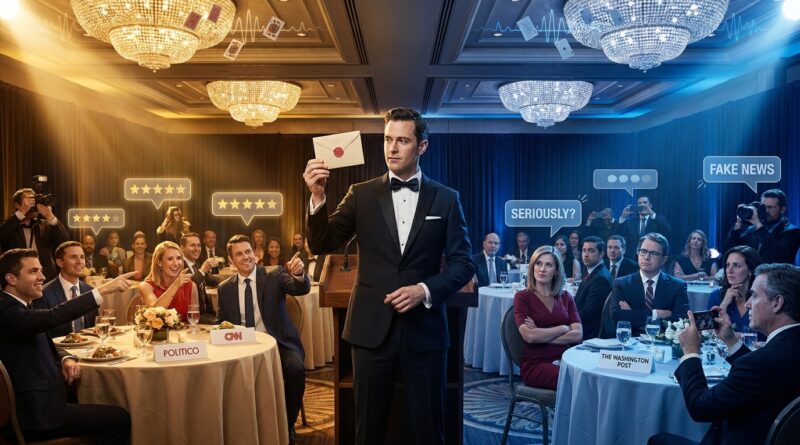
Inside 2026’s New ‘White House Mentalist’ Shift: How Oz Pearlman Quietly Turned Political Roast Night Into The Year’s Most Polarizing Five‑Star Mind‑Reading Review
It is frustrating when a big public event suddenly turns a performance art into a political Rorschach test. One night people are asking whether Oz Pearlman was sharp, original, and crowd-ready. The next, they are arguing about what it means that a White House dinner swapped a roast-style comic set for a mentalist. That is why the burst of interest around Oz Pearlman White House Correspondents Dinner mentalist reviews matters more than it first appears. This was not just another celebrity booking. It put mentalism in one of the most tense, overanalyzed rooms in America, where every pause, reveal, laugh, and awkward reaction gets clipped, reposted, and rated by people who may not even like the art form. For fans trying to judge what happened fairly, the real question is simple. Did this elevate mentalism by showing how strong it can be under pressure, or did it blur the line between technical skill and political theater in a way that will distort reviews all year?
⚡ In a Hurry? Key Takeaways
- Oz Pearlman’s White House dinner appearance was a real visibility win for mentalism, but the reviews around it are being filtered through politics as much as performance quality.
- If you are reading reactions, separate comments about method, pacing, audience control, and hit rate from comments that are really about the event, the guest list, or the politics in the room.
- One viral performance can skew public ratings fast, so casual viewers should avoid using a single headline event as the only proof that someone is, or is not, world-class.
Why this booking felt bigger than a normal celebrity appearance
The White House Correspondents Dinner is usually judged like a political pressure cooker. Comedians get measured on who they mocked, who laughed, and who looked annoyed on camera. A mentalist walking into that same room changes the rules instantly.
Instead of one long monologue, you get a performance built on suspense, prediction, audience handling, and trust. That sounds like a small format change. It is not. It changes what the room expects and how the internet responds afterward.
With Oz Pearlman, the reaction was always going to be unusually intense because he is already seen by many fans as a polished, mainstream-friendly mentalist with strong TV instincts. Put someone like that in a room packed with journalists, politicians, and cameras, and the review cycle stops being about tricks alone.
It becomes a referendum on taste, tone, and timing.
What made the night so polarizing
1. The event itself came with baggage
People did not walk into this night as neutral observers. Some viewers missed the traditional roast energy. Others liked the idea of replacing direct political comedy with something that felt less combative on paper. So before Pearlman even performed, the room already had two different standards for success.
That matters because reviews were never just asking, “Was the mentalism good?” They were also asking, “Was this the right kind of act for this event?”
2. Mentalism looks easy when it is done well
This is one of the oldest problems in the art. A strong mentalist can make a difficult routine feel effortless. To casual viewers, that can strangely lower the perceived skill. If they do not understand the structure, they may think, “That was neat,” instead of, “That was incredibly hard to land in a hostile room.”
At a White House dinner, where viewers are primed for punchlines and conflict, subtle excellence can get underrated.
3. Every reaction shot became part of the review
A politician smiling politely. A reporter looking skeptical. A table laughing late. Online, those moments become evidence for whatever story the viewer already wants to tell. Suddenly the crowd response gets treated like a scorecard, even though reaction shots are one of the least reliable ways to judge live performance quality.
So, was this a win for mentalism?
Yes, with an asterisk.
It was a win because a high-level mentalist got one of the most visible non-sports, non-awards-show stages in the country. That alone tells bookers something important. Mentalism is not just a casino, theater, or corporate breakout-room act anymore. It can carry a national-event slot where the room is smart, cynical, distracted, and hard to impress.
That is not small.
But the asterisk matters. When a performance happens inside a politically charged event, the applause and the backlash do not stay in their lanes. A five-star review may partly mean “I liked the mood shift.” A one-star slam may partly mean “I wanted sharper political comedy instead.” Neither tells you enough on its own about the actual craft on display.
How this will affect mentalist reviews over the next year
The biggest effect will not be on professionals. It will be on casual raters.
When people search for a performer after a major mainstream appearance, they bring the headline with them. That is exactly what happens with searches around Oz Pearlman White House Correspondents Dinner mentalist reviews. The event becomes the lens through which people rate older clips, current ticket sales pages, and even unrelated live shows.
Here is how that ripple usually works:
Critics start using bigger, looser words
After a headline appearance, reviews often drift from specifics into brand labels. You start seeing terms like “safe,” “slick,” “elite,” “TV-ready,” or “surprisingly intimate.” Those words are not useless, but they can flatten the real discussion.
A mentalist is not great because a critic calls them “presidential.” They are great because they manage information, tension, audience psychology, and reveal timing at a very high level.
Star ratings get less precise
A normal review might score pacing, audience participation, originality, and ending strength. A politically charged event often scrambles that. Suddenly the star rating reflects whether the reviewer approved of the booking choice itself.
This is one reason fans should be careful when comparing broad public ratings after a big media moment.
Bookers start chasing “headline energy”
Some event planners will look at this kind of appearance and think, “We want a mentalist because it feels classy, modern, and less risky than a comic.” Others will take the opposite lesson and decide that mentalism now carries political or cultural baggage of its own.
Both reactions can shape who gets hired next.
If you want a useful parallel, the review economy around live mind reading has already been shifting toward audience-led verdicts instead of old media gatekeepers. That is why pieces like Inside 2026’s New ‘Vegas Review War’: Why Everyday Fans, Not TV Producers, Are Quietly Deciding Who The World’s Top Mentalists Really Are feel so relevant here. A major national appearance can spark attention, but everyday audience reactions still shape long-term reputation more than one prestige booking does.
A simple framework for judging the performance fairly
If you want to separate craft from hot-takes, use four questions.
Did the effects read clearly to non-experts?
A great mentalism set in a room like this has to be instantly understandable. If the audience cannot track what the prediction was, what the choice was, or what the impossible moment is, the routine may be technically good but poorly fitted for the setting.
Did he control the room?
This is huge. A correspondents dinner is not a quiet theater. It is a social room. Glasses clink. People talk. Attention drifts. If a mentalist can keep the room focused without seeming stiff or needy, that is a major mark in their favor.
Did the reveals build, not just land?
One lucky-seeming hit is not enough. Strong mentalism creates a sense that the impossible is escalating. The best performers do not just surprise you once. They make the room feel as if each phase raises the stakes.
Would the act still impress outside this event?
This is the best filter of all. Imagine the same material in a theater, corporate event, or TV special. Does it still feel world-class? If the answer is yes, you are probably looking at real skill. If the answer is no, then the room and the headlines may be doing too much of the work.
Why casual viewers often misread mentalists after moments like this
There are two common mistakes.
First, people confuse familiarity with simplicity. Oz Pearlman has a style that often feels approachable and polished. That can lead viewers to underrate how hard it is to get clean reactions without looking overly theatrical.
Second, people treat controversy as a quality signal. If the performance split the internet, some assume that means it must have been either brilliant or terrible. Usually it means the event itself was loaded, and the act got caught in the middle.
What this means for other mentalists
This is not just about one performer.
When a top-tier mentalist gets a national-stage booking, everyone else in the field feels it. Rising performers may benefit because buyers suddenly remember mentalism exists as a premium entertainment option. But they may also face harder expectations from clients who now want “that White House level thing” without really understanding what made that booking unusual.
Reviewers also start comparing unlike with unlike. A 90-minute Vegas show, a 12-minute political dinner set, and a private corporate keynote appearance are totally different jobs. Yet after a giant media moment, people often act like they can be rated on one flat scale.
That is where the conversation gets sloppy.
At a Glance: Comparison
| Feature/Aspect | Details | Verdict |
|---|---|---|
| Visibility boost | A White House dinner booking put mentalism in front of journalists, political insiders, and casual viewers all at once. | Strong win for awareness |
| Review quality | Many reactions mixed performance judgment with opinions about politics, tradition, and event tone. | Useful, but noisy |
| Impact on future bookings | Event planners may see mentalists as safer than comics, or wrongly expect every mentalist to fit high-pressure national stages. | Potentially big ripple effect |
Conclusion
The smartest takeaway is not to crown or dismiss anyone based on one politically charged night. This appearance mattered because it put elite mentalism in one of the most watched, tense, and opinion-heavy rooms in the country. That gives fans a rare chance to see how the craft holds up when journalists, partisans, and casual viewers are all judging it in real time. The useful move now is to watch closely, read reviews carefully, and separate technical mastery from event-driven noise. If you do that, you get something far more valuable than a hot take. You get a better way to judge who is truly world-class, which reviews are reacting to skill, and which ones are really reacting to the room.