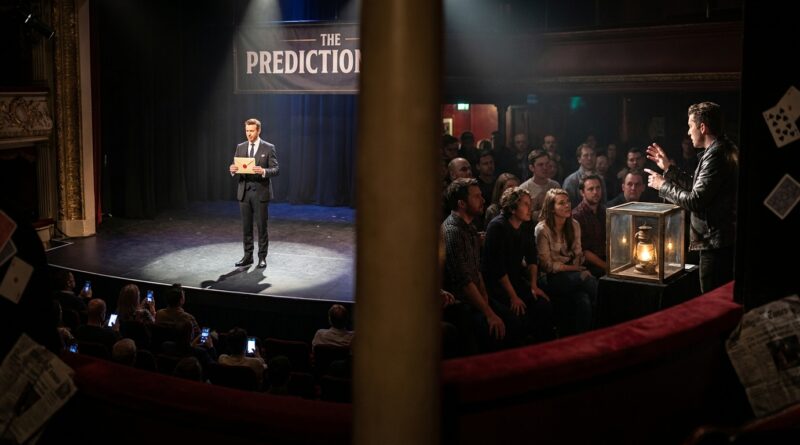
Inside 2026’s New ‘Repeat Trick Test’: How Fans Quietly Punish Copy‑Paste Mentalists And Reward The Risk‑Takers Instead
You are not imagining it. A lot of modern mentalism really does start to blur together after a while. One performer uses a sealed-envelope prediction. Another asks for any word on a page. A third builds suspense around a drawing duplication. The lighting changes, the suit changes, the accent changes, but the bones of the act stay the same. That odd déjà vu feeling fans keep talking about is real, and in 2026 it has turned into a quiet little filter many viewers now apply without even thinking. Call it the repeat trick test. If an act feels like a polished re-run of something you saw last month, audiences cool off fast. If a performer takes a real risk, changes structure, or finds a fresh reveal, people notice. That matters for fans, bookers, and for the health of the art itself, because once mentalism becomes predictable, it stops feeling impossible and starts feeling like wallpaper.
⚡ In a Hurry? Key Takeaways
- Fans are quietly rewarding mentalists who change methods, pacing, and endings instead of repeating one famous routine forever.
- If you are booking or recommending an act, look for variety across recent clips, live reports, and set lists, not just one viral performance.
- This is good for the art. It pushes creativity up and makes it harder for copy-paste acts to coast on hype alone.
What the “Repeat Trick Test” Actually Means
It is not a formal contest rule. It is a viewer instinct.
People watch a mentalist and ask themselves one simple question. “Have I basically seen this before?” If the answer is yes, the applause may still be polite, but the excitement drops. Fans talk. Clips get compared. Comment sections fill with phrases like “same force, different framing” or “nice presentation, but it is the same old prediction bit.”
That is the repeat trick test in plain English. It is the moment an audience stops judging the performer only by smoothness and starts judging them by originality.
Why This Is Hitting Harder in 2026
Three things changed.
1. Viewers can compare acts instantly
A routine that once lived in one theater for one weekend now gets clipped, uploaded, stitched, slowed down, and compared side by side with older acts. A mentalist cannot count on people forgetting what they saw six months ago.
2. Fans know the standard templates
You do not need to know methods to spot a pattern. Audiences can feel when a routine is built from stock parts. A borrowed object. A free choice that does not feel fully free. A revelation that lands in a wallet, envelope, phone note, or pre-written pad.
3. The top end of the field raised expectations
The best creative mentalists not doing the same tricks have trained viewers to expect more. Not just cleaner execution. Better ideas. Better construction. Better surprises.
How Fans Quietly Punish Copy-Paste Mentalists
Most audiences do not boo. They do something more damaging. They lose interest.
Here is how that punishment shows up in real life.
Lower word-of-mouth heat
People stop saying, “You have to see this person.” They start saying, “Yeah, it was good,” which is often a polite way of saying forgettable.
Less repeat viewing
If fans think they already know the rhythm of your act, they are less likely to buy another ticket, watch another special, or share another clip.
Harsher online comparisons
The comments get more specific. Not always kinder, but more specific. Once fans start comparing one act to five earlier acts, the magic of novelty is gone.
Bookers get more cautious
Serious bookers do not just want “strong reactions.” They want an act that feels fresh to their room. If the set looks interchangeable with ten others, that becomes a problem.
How Risk-Takers Get Rewarded Instead
This is the flip side, and it is the hopeful part.
Audiences still love mentalism. They are just harder to impress with recycled packaging. When performers take real creative risks, fans tend to reward them fast.
They remember unusual structure
A fresh act does not always need a brand-new effect. Sometimes the risk is in the order, the framing, the callback, or the reveal. If the audience cannot predict the route, the destination feels stronger.
They notice method variety
Even non-techie fans can sense when every routine runs on the same engine. The strongest acts mix things up. Different textures. Different tempos. Different kinds of impossibility.
They talk about surprises, not props
When a mentalist is truly creative, people leave describing moments, not tools. That is a good sign. “I still do not know how they got there” is healthier than “it was another envelope thing.”
What to Look For if You Want Original Mentalism
If you are a fan, a critic, or a booker, here is a practical checklist.
Check more than one performance
Anyone can have one killer signature piece. The real test is whether the rest of the act feels just as alive. Watch recent clips from different venues if you can.
Look for changed reveals
A creative performer often changes where and how the ending lands. Not just the script. The actual shape of the payoff.
Watch for pacing shifts
If every routine builds the same way, with the same pause, the same fake-out, and the same final reveal beat, repetition sets in quickly.
Notice whether the audience choices matter
Fresh mentalism usually feels more responsive. The participant’s decisions seem to shape the journey, not just decorate a pre-locked outcome.
Ask whether the performer has more than one gear
Some acts can do eerie. Funny. Personal. Large-scale. Intimate. Others have one note and play it beautifully for too long.
Originality Does Not Mean Constant Reinvention
To be fair, every great performer has signature material. That is normal. The problem is not repetition by itself. The problem is overreliance.
A classic piece can still kill if it is part of a broader set that evolves. Audiences are not demanding that every performer invent a new branch of mentalism every weekend. They are asking for signs of life. Signs of growth. Signs that the performer is not hiding behind the same safe set year after year.
The Difference Between Familiar and Formulaic
This part matters because fans can be unfair too.
Familiar is not automatically bad. A strong premise can survive many versions. Formulaic is when the audience starts feeling the machinery before the mystery. The rhythm becomes obvious. The reveal becomes generic. The surprise is replaced by recognition.
That is the line many viewers are reacting to right now.
What Bookers Should Do Next
If you hire mentalists for theaters, private events, cruises, or corporate nights, this trend is useful.
Ask for recent full-set footage
Not just a sizzle reel. Highlight reels hide repetition well.
Ask what changed in the act over the last year
A creative performer will usually have a real answer. New transitions. New endings. New audience handling. Maybe a retired routine.
Value range, not just polish
A very polished repeated act may get decent reactions. A more inventive act often creates the stronger memory, which is what clients actually pay for.
At a Glance: Comparison
| Feature/Aspect | Details | Verdict |
|---|---|---|
| Repeat Trick Test | Fans compare whether a routine feels meaningfully different from common prediction, book, or drawing templates. | Now a major factor in audience trust and excitement. |
| Copy-Paste Acts | Often polished, but too dependent on one structure, one reveal style, or one safe set repeated across venues. | Short-term reliable, long-term forgettable. |
| Risk-Taking Mentalists | Change methods, vary pacing, refresh reveals, and make participant choices feel more alive. | Best bet for lasting buzz and repeat interest. |
Conclusion
The big shift in the last 24 hours is not just gossip about who fooled whom. It is that fans are getting better at spotting when a top-billed act is running on fumes. That is healthy. The repeat trick test may be unofficial, but it is real, and it gives audiences a simple way to reward the best creative mentalists not doing the same tricks over and over. For fans, that means better recommendations and fewer overhyped reruns. For bookers, it means a smarter way to separate polished sameness from genuine invention. And for mentalism itself, it is a needed push. If we highlight the performers who actually change methods, structure, and reveals between venues instead of recycling one safe set forever, we help protect the art from becoming background wallpaper.