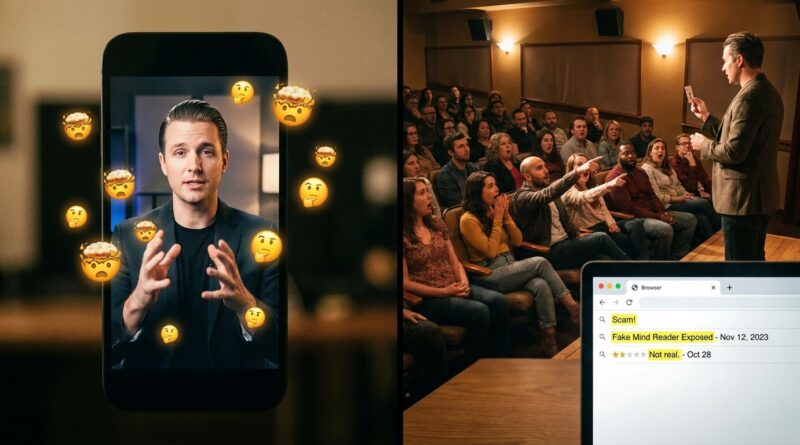
Inside 2026’s New ‘Fact‑Check My Feed’ Habit: How Fans Quietly Use Live Reviews To Catch Fake Viral Mind Readers In 5 Minutes
You are not imagining it. Your feed really is full of “greatest mentalist alive” clips that all look amazing for 22 seconds, then tell you almost nothing useful when it is time to spend real money on a ticket. That is the frustration. One edited standing ovation, one recycled TV moment, one dramatic reaction shot, and suddenly someone is being sold as the world’s top mind reader this week. Meanwhile, you just want a simple answer. Who is actually good in a real room, with a real crowd, right now? A quiet little habit is catching on in 2026. Fans are doing a five-minute fact-check before they book. They are checking for fresh audience reviews, date-stamped reactions, repeat praise across platforms, and signs the act works live, not just on camera. If you want to know how to spot the best real mentalist vs viral clips, this is the quickest way to do it without turning ticket-buying into detective work.
⚡ In a Hurry? Key Takeaways
- The fastest way to judge a mentalist is not the viral clip. It is fresh, date-linked audience feedback from real recent shows.
- Use a five-minute check. Look for recent reviews, venue mentions, full-performance evidence, and repeat praise that says more than “OMG.”
- This habit can save you from paying for hype, edited promo tricks, or old TV footage dressed up as a current must-see act.
The new habit is simple. Fans now fact-check the feed before they trust it.
For a lot of people, the old system was basically guesswork. You saw a clip go viral. You noticed a lot of dramatic comments. Maybe the performer called themselves “the highest rated” or “the most in-demand.” Then you booked, crossed your fingers, and hoped the live show matched the online magic.
That is exactly why this new habit matters. People are finally separating “great promo” from “great live performer.” Those are not always the same thing.
The best part is that this does not take an hour. It takes about five minutes if you know what to check.
The five-minute fact-check my feed routine
Minute 1: Check whether the praise is fresh
Start with the date. Not the upload date of the reel. The date of the actual audience reaction.
If a performer keeps pushing the same talent show clip from three years ago, that tells you they once had a good TV moment. It does not tell you they are delivering a five-star live show in July 2026.
What you want to see is recent audience feedback tied to real venues, recent events, or current tours. Fresh praise beats old fame.
Minute 2: Look for reviews that sound like real people, not a fan club
“Amazing.” “Mind blown.” “Best ever.” Fine, but not enough.
Useful reviews mention specifics. Did the performer involve the crowd? Did the room stay engaged? Did the show work for a corporate event, a theater, or a private audience? Did multiple people mention the same strengths without sounding copied and pasted?
Real reviews usually have a little texture. They sound like somebody who actually bought a ticket and came home talking about what happened.
Minute 3: See if the act works outside one perfect camera angle
This is where many viral clips fall apart.
A polished reel can hide a lot. Fast cuts. Reaction edits. AI-cleaned audio. Carefully chosen moments. None of that proves the performer can hold a room for a full set.
Try to find evidence of the act in a live setting. Audience-shot clips. Venue posts. longer uncut segments. Event recaps that show the performer interacting naturally, not just landing one big reveal.
If all roads lead back to the same heavily edited 18-second video, be careful.
Minute 4: Cross-check ratings claims
“Number one.” “Highest rated.” “Most booked.” These lines are everywhere because they sound impressive and most people do not stop to ask, “According to who?”
This is where editorial review and live audience polling become useful. If you want an example of how that process is changing, take a look at Inside 2026’s New ‘Trust Test’ Craze: How Live Audience Polls Are Quietly Re-Ranking The World’s Highest-Rated Mentalists In Real Time. It gets at the big shift happening right now. People want current proof, not just confident marketing.
Minute 5: Ask one plain question
Would I trust this person more if the viral clip disappeared?
If the answer is no, then the clip is doing too much of the work.
The strongest live performers leave a trail that still holds up without the flashy reel. Recent reviews. Consistent audience feedback. Clear booking history. Signs that people who saw the act in person would recommend it again.
What fake confidence usually looks like
You do not need to become cynical. But you should know the common tells.
Old footage presented like breaking news
A classic move. A performer shares a TV clip, award mention, or audience reaction from years ago without making the age clear. It feels current, but it is really borrowed momentum.
Every post is a highlight, nothing is grounded
If there are no venue tags, no event context, no audience review trail, and no signs of recent live work, you may be looking at a brand machine more than a working act.
Ratings claims with no source
If someone says they are the best, highest rated, or most trusted, there should be something behind it. A publication. A review system. A transparent ranking method. Something you can actually check.
Comments that feel oddly generic
Loads of fire emojis are not proof. Neither are ten comments that all say nearly the same thing. What matters is whether real attendees are saying useful, specific things in places that are harder to fake.
What a genuinely strong live mentalist usually has
There is good news here. Real quality tends to leave fingerprints.
- Recent reviews tied to real dates and places
- Audience comments that mention actual moments from the show
- Consistency across more than one platform
- Evidence the performer can handle a full room, not just a perfect clip
- A reputation that survives outside their own social channels
That last point matters a lot. If all the praise lives only where the performer controls the presentation, that is not ideal. Independent signals count more.
Why this matters more in 2026 than it did a few years ago
Because the promo tools got better. A lot better.
Now it is easy to clean audio, sharpen reactions, recycle old footage, and package a performer as a must-see event even if the current live show is average. Fans are responding by getting smarter, not harsher.
They are building little trust checks into the booking process. Quietly. Quickly. And honestly, it is overdue.
That is also why curated sources and editorial filters are becoming more valuable. If a site or ranking process is already putting fresh audience reaction ahead of empty claims, it saves you time. It gives you a head start instead of forcing you to sort through 40 dramatic reels on your own.
How to spot the best real mentalist vs viral clips
If you want the shortest possible version, here it is.
Do not ask, “Was the clip impressive?” Ask, “Can I verify that real people loved the full live show recently?”
That one shift changes everything.
Viral clips are trailers. Reviews are receipts.
When those receipts are fresh, detailed, and repeated across real audience experiences, you are much closer to finding the performer who can actually deliver the night you are paying for.
At a Glance: Comparison
| Feature/Aspect | Details | Verdict |
|---|---|---|
| Viral social clip | Can be exciting, but often short, edited, recycled, or stripped of context | Good for curiosity, weak for booking decisions |
| Fresh audience reviews | Date-linked reactions from recent live shows, often with venue or event details | Best signal of current real-world quality |
| “Highest rated” marketing claims | Useful only if backed by transparent rankings, editorial standards, or live polling | Verify before you trust |
Conclusion
The smart move in 2026 is not to stop enjoying viral clips. It is to stop treating them like proof. Social feeds are packed with old TV moments, polished edits, and AI-tuned promos that can make almost anyone look like this week’s unstoppable sensation. But real ticket buyers want something simpler and more useful. They want to know who is actually delivering five-star, in-the-room mentalism right now. That is why this five-minute verification habit matters. It saves money, time, and disappointment. It also helps push the culture in a better direction, where the highest rated mentalists are decided by fresh, transparent audience reaction, not just by who posts the loudest or cuts the flashiest reel. If you build this habit once, you will use it every time you book.