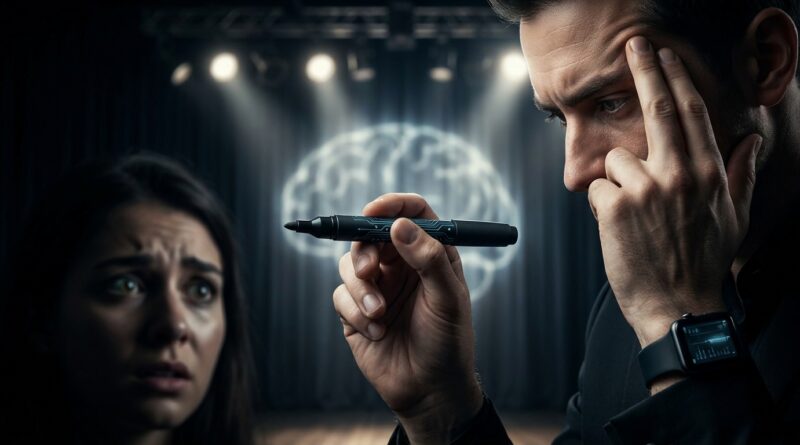
Inside 2026’s New ‘Smart Gadget Test’: How High‑Tech Props Quietly Split The World’s Highest‑Rated Mentalists Into Two Camps
You are not imagining it. One minute you are watching a “world-class mentalist” on your phone, and the next you spot a smart pen, a flashy watch, or an app peeking out from the performance. Then the comments turn into a food fight. “Real mind reader.” “Nope, just tech.” “Still amazing.” “Total gimmick.” It is frustrating, especially when both kinds of acts keep picking up glowing five-star reviews. If you are trying to work out the best mentalist smart pen watch app real mind reader or gimmick question, here is the simplest test I know. Ask this: would the performance still feel elite if every gadget stopped working right now? That one question quietly splits today’s top-rated mentalists into two camps. One group uses tech as seasoning. The other needs it as the main ingredient. For fans, buyers, and event planners, that difference matters more than ever.
⚡ In a Hurry? Key Takeaways
- A smart pen, watch, or app does not automatically make an act fake. The real question is whether the performer still looks exceptional without it.
- When judging a mentalist, look for strong no-tech moments, clean audience interaction, and effects that do not depend on a device being hidden in plain sight.
- This matters because reviews often rate entertainment value, not method. A five-star show can still rely heavily on gadgets.
The new split fans are noticing
For years, mentalism had a simple public image. A person walks onstage, seems to read thoughts, and leaves everyone arguing in the car afterward.
Now the props are louder. Pens look expensive. Watches get camera close-ups. Phone screens appear at just the right moment. That has created a new split among top-rated performers.
Camp one uses high-tech tools to support an already strong skill set. If the app crashes, they can pivot. If the pen disappears, the act still works. You are watching a mentalist who happens to use modern tools.
Camp two builds the biggest reactions around the tools themselves. Take away the hidden electronics, and a lot of the mystery goes with them. You are watching a gadget-driven act with a mentalism finish.
Both camps can entertain. Both can get applause. Both can even earn rave reviews. But they are not the same thing.
The one evaluation lens that clears up the confusion
Ask the blackout question
Here it is again because it is so useful. If every battery died, every app froze, and every smart accessory vanished, would this person still look like an elite mentalist?
If the answer is yes, you are likely looking at real craft first, technology second.
If the answer is no, you are probably looking at a polished operator using gadgets to create the strongest moments.
This is not meant as an insult. Plenty of gadget-heavy performers are excellent entertainers. But if you are trying to sort out “highest-rated” from “highest-skilled,” this test cuts through the marketing fast.
Why five-star reviews are not enough anymore
Review sites usually tell you whether people had a good time. They rarely tell you how the impact was created.
That is a big gap.
An audience member may leave a review saying, “He knew exactly what I wrote on the card.” Fair enough. But they often cannot tell whether that result came from deep audience reading, classic method, sharp stage control, covert electronics, or some mix of all four.
So yes, a tech-heavy performer can deserve five stars for entertainment. But that does not automatically settle the question of whether they belong in the elite “real mind-reader” conversation.
What high-tech props actually do well
They can make an act smoother
Smart pens, watches, and apps can speed things up. They reduce dead time. They can make reveals cleaner and more direct.
They fit modern audiences
A phone-based effect feels current because phones are part of daily life. For some viewers, that makes the impossible feel more personal.
They can raise the ceiling on spectacle
Tech can help create giant reveals, impossible-looking predictions, and slick moments that play well on social media.
None of that is bad. In fact, used well, it can be impressive. The trouble starts when people confuse “looked impossible on camera” with “this performer has top-tier mentalism chops.” Those are not always the same thing.
How to spot a craft-first mentalist
They are strong before the reveal
Watch what happens in the buildup. Is the performer controlling attention, reading the room, and making choices feel natural? Or are they mostly steering everyone toward a device-assisted ending?
They can work clean and light
Top mentalists often do at least part of their best work with minimal props. A billet, a drawing pad, a few words, a borrowed item. Nothing flashy. Still devastating.
They recover well
Real experts are hard to shake. A joke lands oddly. A volunteer hesitates. The room changes. They adjust without panic. Gadget-reliant acts can look brittle when the conditions shift.
They create mystery, not just surprise
A device can help deliver a surprise. Real mentalism craft builds a deeper feeling. People do not just think, “How did he do that?” They think, “That should not have been possible, even with a trick.”
How to spot a gadget-first act
The props keep showing up at the critical moment
If the watch, pen, or phone is always near the method-heavy parts, pay attention. That does not prove anything by itself. But patterns matter.
The strongest effects feel tech-shaped
Maybe every impossible moment happens after someone writes in a special pad, taps a phone, or handles a branded object supplied by the performer. Again, not proof. But it tells you where the engine may be.
The performer avoids stripped-down demonstrations
If an act never risks a simple, low-prop demonstration, that is a clue. The best often can. The most dependent often do not.
The wow is bigger than the interaction
With gadget-first acts, the reveal can be huge while the human side feels thin. It is more “system executed perfectly” than “mind met mind.”
So, is it real or a gimmick?
Usually, it is neither extreme.
Mentalism has always mixed psychology, theatre, suggestion, old-school methods, misdirection, and sometimes new tools. The smart way to judge it is not by asking whether technology exists. It obviously does. The smarter question is how much weight that technology is carrying.
If the prop is doing a little lifting, fine. If it is carrying the whole sofa, you should know that before calling someone the best.
What to ask before booking or recommending a performer
For event planners
Ask whether the show includes low-tech or no-tech routines. Ask what happens if venue Wi-Fi is poor, if phone use is restricted, or if lighting changes. A seasoned performer will answer calmly and clearly.
For fans comparing viral clips
Do not judge from one video. Social clips are edited, framed, and built for argument. Look for full performance footage, live audience reactions, and variety across different settings.
For reviewers
Separate “I loved it” from “this depended mainly on hidden tech.” Both are fair observations. Mixing them together is what confuses the public.
Why this debate matters more in 2026
Because tech has become small, wearable, and easy to hide in plain sight. It no longer screams “gimmick.” It blends into normal life. That makes audiences easier to fool, but it also makes serious comparison harder.
And once five-star ratings pile up, a gadget-heavy act can sit right next to a craft-first mentalist in search results, ticket pages, and “best of” lists. To a casual fan, they can look equal. Under the hood, they may be doing very different work.
At a Glance: Comparison
| Feature/Aspect | Details | Verdict |
|---|---|---|
| Role of gadgets | Craft-first mentalists use pens, watches, or apps as support. Gadget-first acts build key miracles around them. | Support is fine. Dependence is the red flag. |
| Performance without tech | Ask whether the act would still feel powerful if every device failed mid-show. | If yes, that points to elite underlying skill. |
| Meaning of five-star reviews | Reviews usually measure enjoyment, not whether the mystery came from deep skill or hidden electronics. | Useful, but not enough on their own. |
Conclusion
The smartest way to judge the best mentalist smart pen watch app real mind reader or gimmick debate is not to panic every time you see a modern prop. It is to use one clean test. Would this act still feel world-class if every gadget vanished tomorrow? That question helps fans cut through hype, helps planners book with open eyes, and helps reviewers talk more honestly about what they are praising. Right now, mainstream audiences are being flooded with viral “proper mind-reading” clips, while comment sections argue about smart pens and phone apps and rating sites keep handing out stars without much detail. A simple lens protects people from overhyped acts, gives proper credit to performers whose skill survives without electronics, and keeps the “world’s highest-rated” conversation focused on real craft instead of the latest shiny tool.