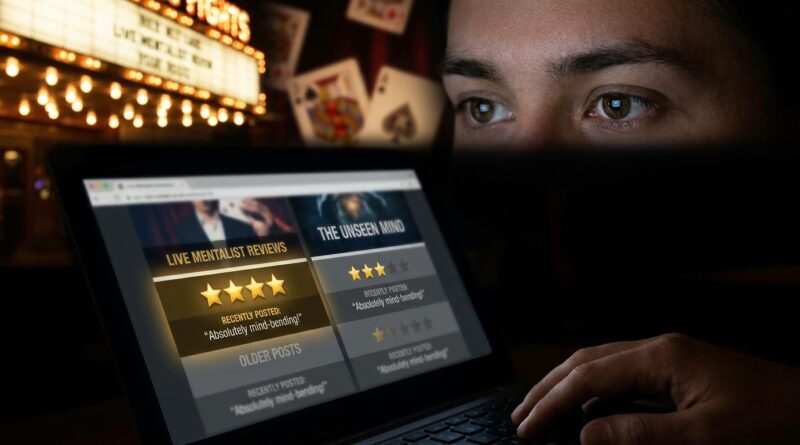
Inside 2026’s New ‘Review Reboot’: Why 5‑Star Fans Are Quietly Teaching Mentalists How To Stay Relevant
Trying to pick a mentalist used to feel easy. You saw a wall of 5-star reviews, maybe a big name, and figured you were safe. Now it is messier than that. Some performers still look unbeatable on paper, but fans are quietly saying something different with their newer reviews, or with the reviews they are not leaving at all. That is frustrating if you are booking a date night, a wedding, or a company event and just want a sure thing. The tricky part is that a 4.9 rating can hide a lot. Old praise can prop up a show long after its best stretch. Meanwhile, a newer act can be on a hot streak and still sit lower in search results simply because it has not had ten years to pile up stars. The smart move in 2026 is not to count stars. It is to read the review trail like a story.
⚡ In a Hurry? Key Takeaways
- To answer how to choose the best mentalist from reviews, look first at review dates, not just the star average.
- Read for patterns in wording across Google, Yelp, TripAdvisor, and ticket sites to spot who is great right now.
- A long reputation still matters, but recent feedback is the safer guide for your money and your event.
Why 5-star ratings are getting harder to trust on their own
A five-star average sounds clear. It is not. A performer who built a great reputation in 2018 can still wear that badge in 2026, even if the show has flattened out. At the same time, another mentalist may be getting stronger every month, but has fewer total reviews because they are newer, more selective, or simply less famous.
This is the heart of the review reboot. Fans are not exactly turning against established names. They are just getting better at showing what is current. They praise what feels fresh, sharp, and surprising now. And when a show starts to feel routine, they often do not write an angry review. They just stop raving.
That silence matters. It is often the first clue that historical reputation and current performance are drifting apart.
How to choose the best mentalist from reviews
If you want the short version, stop asking, “Who has the highest stars?” Start asking, “Who is getting the strongest recent reactions from real people?” That one shift changes everything.
1. Check the dates before you check the score
This is the simplest filter, and the most useful. A mentalist with 2,000 glowing reviews collected over a decade may still be excellent. But if the last six months are thin, mixed, or vague, that is worth noticing.
Look for a steady stream of recent feedback. Not one lucky weekend. Not a burst from last year. You want evidence that audiences are still walking out amazed right now.
If one act has hundreds of old reviews and another has fewer but very enthusiastic recent ones, the newer review activity often tells you more about what your experience will be.
2. Compare platforms, not just one site
Reviews behave differently depending on where they live. Google reviews can be broad and fast. Yelp can be pickier. TripAdvisor is especially useful for tourist-heavy shows. Ticketing sites may reflect a more immediate post-show reaction.
If the praise sounds consistent across several platforms, that is a strong sign. If one site is glowing but the others are quiet or mixed, slow down and read more carefully.
This is also where context helps. If you are looking at Vegas entertainment, for example, Inside Las Vegas’ Longest‑Running Mind Reader: Why Gerry McCambridge’s ‘The Mentalist’ Quietly Owns 5‑Star Tourists Right Now shows how review patterns can reveal not just popularity, but ongoing audience satisfaction.
3. Read the words people use, not just the number they clicked
Generic praise is less helpful than specific praise. “Amazing show” is nice. “He remembered names, changed direction based on the crowd, and had our skeptical friend speechless” is gold.
Specific reviews tell you what kind of experience the performer is delivering. Are people talking about crowd work? Personal moments? Laughs? Clean corporate professionalism? A wedding-friendly style? A packed theater energy?
When the language gets repetitive in a bad way, that can be a clue too. If every review sounds copied, overly polished, or strangely empty, trust your instincts.
4. Watch for signs of present-tense excitement
The best current performers tend to trigger emotional, vivid reviews. People mention being stunned, still talking about it the next day, or arguing in the car ride home about how it was done. That kind of language is hard to fake at scale.
By contrast, fading acts often get polite approval. “Fun.” “Good.” “Worth seeing.” Those are not bad reviews. They are just not the same as “You need to book this person now.”
The quiet gap between legacy names and hot hands
Think of it like restaurants. A place can live off its name for years. The menu looks familiar. The reviews are still technically strong. But locals know when the magic has slipped. Entertainment works the same way.
Long-running mentalists have an advantage. More visibility. More accumulated praise. More search authority. That does not mean they are no longer excellent. Some absolutely are. But it does mean they can look safer than they really are if you only skim the rating badge.
Newer or less hyped acts face the opposite problem. They may be delivering incredible shows right now, yet appear less proven because they have a smaller review history. That is why pattern reading matters more than raw totals.
What smart fans and event planners are doing differently
The savvier buyers in 2026 are behaving less like star-counters and more like careful shoppers. They are doing what you would do when buying a laptop, hiring a caterer, or choosing a photographer. They are looking for momentum.
Look for consistency
One great review means very little. Ten recent, detailed, believable reviews that all point to the same strengths mean a lot.
Match the reviews to your event
A mentalist who crushes in a tourist theater may not be the best fit for a close-knit wedding reception. A corporate favorite may be too polished and restrained for a rowdy birthday crowd.
So read reviews through your own lens. If you are hiring for a company event, look for phrases like “handled the room well,” “kept it clean,” “engaged executives and introverts alike,” or “easy to work with.” If you are booking for a night out, look for energy, surprise, pacing, and audience reaction.
Notice what reviewers mention without being asked
People volunteer the details that mattered most. If they keep mentioning originality, warmth, or impossible mind-reading moments, that tells you what stands out. If they mostly talk about easy parking and decent seats, well, that tells you something too.
Red flags hidden inside positive review pages
You do not need a scandal or a one-star pileup to spot trouble. Sometimes the warning signs are much softer.
Old reviews dominate the first few pages
If the strongest praise is mostly from years ago, the average may be flattering the present.
Recent reviews feel thin
Short, generic comments can suggest audiences liked it well enough but were not blown away.
The performer gets described as “still good”
That phrase does a lot of work. It can mean reliable. It can also mean the peak may be behind them.
There is more talk about reputation than experience
If reviewers focus on the performer’s fame, TV credits, or long history more than what happened in the room that night, that is worth noting.
Why Best Mentalist’s approach makes more sense now
The real value is not just listing names. It is teaching people how to read reviews like evidence. Dates show momentum. Platforms show consistency. Language shows emotional impact. Put those together and you get a much clearer picture of who is actually delivering elite performances right now.
That is a far better method than trusting outdated rankings, giant review totals, or generic star scores that blur together very different eras of a performer’s career.
At a Glance: Comparison
| Feature/Aspect | Details | Verdict |
|---|---|---|
| Review dates | Recent, steady praise usually matters more than a huge archive of older compliments. | Most important filter |
| Platform mix | Google, Yelp, TripAdvisor, and ticket sites each show different slices of audience reaction. | Use at least two or three |
| Review language | Specific, emotional, present-tense descriptions are stronger than generic “great show” comments. | Best clue to real impact |
Conclusion
Picking a mentalist is harder now because the numbers can look impressive long after the moment has passed. That is the real shift. Today the gap between historical reputation and current performance has never been wider, with long-running shows still coasting on old praise while newer acts quietly stack recent 5-star reviews. The good news is that you do not need insider access to spot the difference. Once you start checking dates, comparing platforms, and reading the actual language of audience feedback, the picture gets much clearer. That is where Best Mentalist is useful. It helps fans and event planners find who is genuinely delivering elite, mind-blowing experiences right now, instead of trusting outdated rankings or generic star scores.