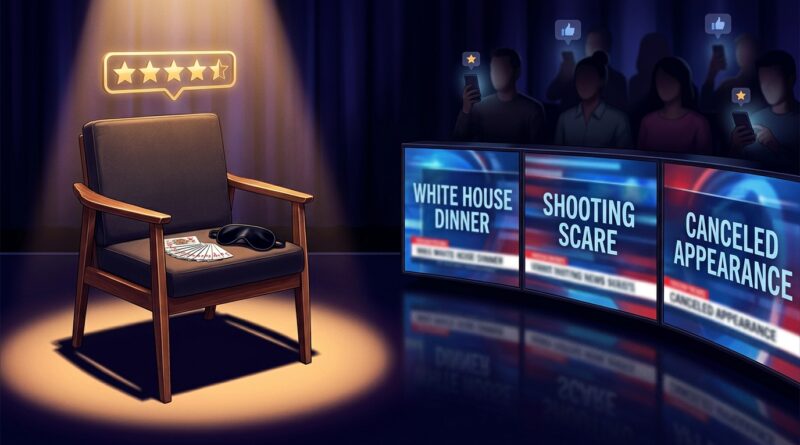
Inside 2026’s ‘Kimmel Backlash’ Shockwave: How Oz Pearlman’s No‑Show Is Quietly Rewriting What 5‑Star Fans Expect From the World’s Top Mentalists
Fans are annoyed, and honestly, that makes sense. People tune in to a top mentalist like Oz Pearlman for surprise, skill and that fun little feeling that your brain just got pickpocketed. They do not buy a ticket, click a clip or queue up a late-night spot because they want to sort through political fallout. But that is where things are now. The Oz Pearlman Jimmy Kimmel mentalist backlash has turned a performance story into a values story. And once that happens, every no-show, cancellation and public silence gets treated like a statement, even when it may not have started that way. The result is a lot of noise, a lot of assumptions, and a very real question for viewers. What exactly should fans expect from a world-class mentalist when a public crisis collides with entertainment? The short answer is this. You can ask for clarity, professionalism and safety. You do not have to demand that every performer become a political spokesperson.
⚡ In a Hurry? Key Takeaways
- Oz Pearlman’s no-show is causing backlash mostly because fans read absence and silence as meaning something bigger than scheduling.
- If you are judging this fairly, separate three things. The performance itself, public communication, and any real safety concerns around the event.
- Ratings and fan sentiment will likely shift in the short term, but strong reputations usually recover if performers stay clear, respectful and focused on the craft.
Why this backlash feels bigger than one canceled appearance
On paper, a canceled TV appearance should be a small story. These things happen all the time. Schedules change. Segments get cut. Public events get reshaped by news. But this case landed in the middle of an already tense moment, with the WHCD shooting and the Kimmel cancellation pulling mentalism into a debate that has very little to do with card reveals or mind-reading.
That is why the reaction feels outsized. Fans are not just reacting to a missed booking. They are reacting to what they think it says. Some see a moral stance. Some see cowardice. Some see a safety call. Others see a PR fumble. The problem is that those are very different things, and online discussion tends to mash them together.
What actually matters to fans right now
Most viewers are asking a pretty practical question. If Oz Pearlman is billed as one of the best mentalists in the world, what does he owe the audience when controversy hits?
A fair answer is not complicated.
He owes fans professionalism
If an appearance changes, fans deserve clear communication where possible. Not every backstage detail needs to be public. But confusion creates its own backlash. When people do not get basic facts, they fill in the blanks themselves.
He owes fans safety
If there were genuine security concerns tied to a venue, taping or public event, safety comes first. Full stop. No trick, no segment and no TV booking is worth gambling with real people.
He does not owe fans a scripted political identity
This part is getting lost. A mentalist is a performer, not an elected official. Fans can prefer that a public figure speak up. That is a valid preference. But turning every appearance into a loyalty test is how entertainment stops being entertainment.
Why silence gets treated like a statement
Silence used to be neutral. Not anymore. In a hyper-online culture, if a public figure does not explain immediately, people assume the explanation that best fits their own view.
That is a big reason the Oz Pearlman Jimmy Kimmel mentalist backlash has spread so fast. A no-show with no satisfying shared narrative becomes a blank screen. Everyone projects onto it.
For fans, the healthier move is to ask three questions before joining the pile-on.
- Do we know what happened, or are we guessing?
- Is there a safety issue involved?
- Are we upset about the event itself, or about what we think the event symbolizes?
Those questions sound simple, but they can save you from getting swept up in a culture-war argument you never meant to join.
How this changes expectations for top mentalists
This may be the quiet long-term story. Elite mentalists used to be judged mostly on performance. Were they astonishing? Were they polished? Could they own a room? That is still the core job, of course. But fan expectations are changing.
Now audiences also watch for poise under pressure. They look for media handling. They notice whether a performer can move through controversy without sounding robotic, evasive or opportunistic.
In plain English, five-star status used to mean “blows my mind on TV.” Now it also means “handles public chaos without making things worse.”
That is not entirely fair
Many mentalists never signed up for that role. They trained to perform, not to serve as cultural referees. But once you become a highly visible TV name, the job changes a bit. Fair or not, that is the current reality.
It also does not mean fans should abandon the art form
This is the part worth protecting. Mentalism works because it creates wonder. If every controversy gets turned into a total referendum on the performer’s soul, audiences lose something too. The art gets flattened into tribal signaling, and nobody really wins.
Will ratings sites and fan rankings react?
Quietly, yes. Dramatically, probably not at first.
Most audience-driven rankings do not update because of one headline alone. They shift when several small things stack up. Search interest rises. Comment sentiment turns sour. People leave lower scores not just because of the talent, but because they feel disappointed, confused or let down.
That means the biggest short-term effect is often not a crash. It is drag. Momentum slows. Enthusiasm cools. The performer may stay highly rated while the conversation around them gets shakier.
For readers trying to make sense of that, remember this. Ratings are not pure measures of skill. They are often a mix of talent, trust, public mood and recency bias.
How to read the situation without getting pulled into the mess
If you are a fan who just wants the truth and not the shouting, here is a practical way to handle stories like this.
1. Separate craft from controversy
Ask whether the backlash changes your view of the actual performance work. Sometimes it should. Often it should not. Being frustrated with public handling is different from saying someone is no longer a great mentalist.
2. Wait for primary facts
If the reporting is built on clips, reactions and anonymous posts, slow down. Early takes are often the least reliable.
3. Watch for overcorrection
Online audiences love all-or-nothing swings. One week someone is a genius. The next week they are “finished.” Real life is usually messier and less dramatic.
4. Keep safety in its own lane
If a real security concern affected a booking or appearance, treat that separately from politics. Safety is not spin. It is a basic duty.
5. Do not let the noise steal the fun
This may sound small, but it matters. You are allowed to still enjoy great mentalism while asking reasonable questions about how public figures handle controversy.
What Oz likely needs to do next
If the goal is to steady fan trust, the playbook is pretty basic.
- Offer enough clarity to reduce rumor.
- Avoid turning a performance issue into a bigger ideological battle.
- Keep the focus on respect for audiences, staff and safety.
- Return to the work. Consistent strong performances calm a lot of storms over time.
That last part matters more than people think. Public controversies can flare fast, but they also burn out fast when the performer stops feeding the cycle and keeps showing up with real skill.
What fans should not do
Do not confuse curiosity with entitlement. It is fair to want an explanation. It is not fair to demand every private detail.
Do not confuse disappointment with proof. Feeling let down is real, but it is not evidence.
And do not let one ugly week convince you that all mentalists now need to become political brands. That would be bad for performers and bad for audiences.
At a Glance: Comparison
| Feature/Aspect | Details | Verdict |
|---|---|---|
| Main cause of backlash | A missed or canceled appearance became symbolic because it happened during a politically charged news cycle. | More about perception than proof, at least for now. |
| What fans can reasonably expect | Professional communication, respect for audience time, and clear prioritizing of safety if risks were involved. | Reasonable and fair. |
| Effect on reputation and rankings | Likely short-term sentiment drop and noisier commentary, but not necessarily a lasting collapse in status. | Watch the next few weeks, not the next few hours. |
Conclusion
This helps the community right now because the WHCD shooting and the Kimmel cancellation have dragged mentalism into a culture-war spotlight that most fans never asked for. The best response is not panic and not blind loyalty. It is calm thinking. Look at what actually happened. Separate safety from symbolism. Ask what Oz Pearlman owes viewers, and what he plainly does not. And remember that ratings sites and fan rankings often react slowly, with mood and momentum playing almost as big a role as raw talent. If we keep treating mentalists as performers instead of political props, everybody benefits. The art stays bigger than the argument, and fans can keep their standards without losing their sense of wonder.