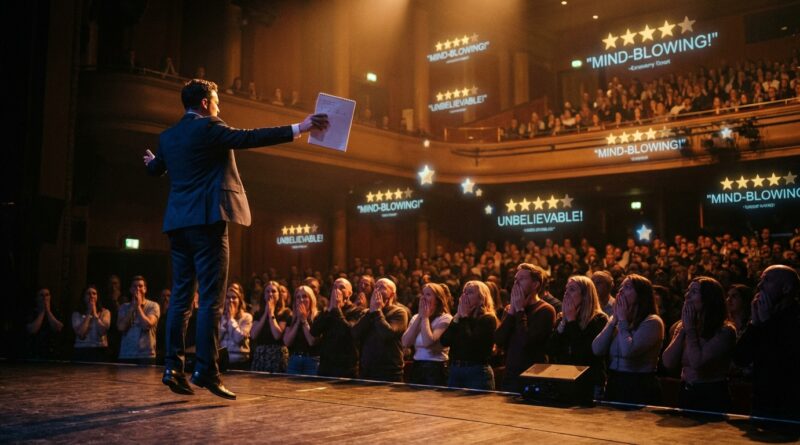
The Real ‘Highest Rated’ Mentalists Right Now: What Today’s Fans Are Secretly Rewarding On Review Sites
You are not imagining it. Trying to figure out the real highest rated mentalist show reviews 2026 has become weirdly hard. Every performer seems to be “world class.” Every poster says “mind blowing.” Every agency bio sounds like it was written by the same person, or worse, by software trained to praise everyone equally. Then you open review sites and find a wall of five-star comments that tell you almost nothing. Was the crowd stunned, or just being polite? Did the show feel personal, or was it a slick sales job with good lighting? That gap matters, especially now, when fresh audience reactions are coming in every day from Las Vegas, cruise lines, private events and touring theaters. The good news is that fans are leaving clues. When you stop looking at star count alone and start reading what people repeatedly praise, a much clearer picture appears of what audiences actually reward right now.
⚡ In a Hurry? Key Takeaways
- The highest rated mentalists in 2026 are not just getting stars. They are getting repeated praise for audience interaction, emotional impact, and shows that feel personal instead of scripted.
- When checking reviews, look for patterns in the wording. “He involved everyone,” “it felt impossible up close,” and “we talked about it all night” mean more than generic “amazing show” comments.
- Be careful with hype-heavy listings. A lower-profile performer with detailed, recent reviews is often a safer pick than a heavily marketed name with vague praise.
What “highest rated” really means in 2026
A few years ago, people often picked a mentalist based on TV credits, a flashy website, or whether the performer had a Vegas residency. That still influences bookings, of course. But reviews show that audiences have moved on a bit.
Today’s fans are secretly rewarding something more specific. They want the show to feel human. Not just polished. Not just mysterious. Human.
That means the highest rated mentalist show reviews 2026 tend to praise performers who create a real connection with the room, adapt to the audience, and make people feel like they were part of something special, not just spectators watching a canned act.
It is a subtle shift, but an important one.
The three things fans keep rewarding on review sites
1. Interaction that feels genuine
Read enough recent reviews and one phrase keeps popping up in different forms. People loved that they were involved.
Not dragged on stage for a cheap laugh. Not used as a prop. Involved.
That is a big difference. Audiences in 2026 seem far more sensitive to whether participation feels respectful and meaningful. The best-reviewed mentalists are the ones who make volunteers feel smart, safe, and central to the mystery.
When reviewers say things like “he made the whole room feel included” or “even from the back row it felt personal,” that is usually a strong sign the performer has figured out the modern audience.
2. Emotional reactions, not just puzzle reactions
People still love being fooled. That part never goes away. But top reviews now often mention emotion before technique.
Words like “moving,” “warm,” “funny,” “thoughtful,” and “unsettling in the best way” show up more often around the strongest-reviewed acts. Fans are rewarding mentalists who do more than prove they are clever. They want a feeling to take home.
This is one reason some of the newer review standouts are gaining ground on bigger names. A show that lands emotionally gets remembered longer than a show that simply racks up impossible moments.
3. Credibility under close review
Here is the thing many performers probably do not love. Audiences are getting better at spotting fake-looking praise.
Generic reviews now raise suspicion. If every comment says “absolutely incredible” and nothing else, fans notice. The performers rising to the top are often the ones with detailed reviews that mention specific bits, audience moments, pacing, humor, venue fit, and how the crowd reacted after the show.
That kind of feedback is harder to fake at scale.
Why star ratings alone are no longer enough
A 4.9 score looks great. So does a sold-out photo. Neither tells you much by itself.
What matters more is the texture of the reviews. Are people saying the same meaningful things, over and over? Are the comments recent? Are they coming from different settings, like Vegas, cruises, corporate events, and theater dates?
If praise stays consistent across those very different environments, that is a sign the performer is not just benefiting from one lucky room or one aggressive marketing push.
This is also why lesser-known names can suddenly become serious contenders. If the live experience is strong enough, review patterns eventually give them away. A good example is the recent attention around Why Vegas Reviewers Are Suddenly Calling Frederic Da Silva ‘The Best Mentalist You’ve Never Heard Of’, which taps into exactly this problem. Sometimes the strongest audience love is hiding behind a name that has less marketing muscle.
How to spot a genuinely loved mentalist in under five minutes
Check for review freshness
Old TV fame can carry a performer for years. But if you want a real answer, start with recent reviews. The newest reactions tell you whether the show still works for current audiences.
This matters a lot in mentalism, where style changes quickly. What felt edgy or elegant five years ago can now feel stiff, distant, or over-rehearsed.
Ignore empty superlatives
“Best ever” is nice. “Top rated” is fine. “World class” means almost nothing now.
Instead, look for concrete details. Did reviewers mention pacing? Audience management? A surprise ending? Did they say skeptics loved it too? Did couples, families, and hardcore magic fans all seem satisfied?
Specific praise beats huge praise.
Notice whether the performer seems kind
This one sounds soft, but it keeps showing up. Fans increasingly reward performers who come off as generous, funny, and calm under pressure.
Why? Because mentalism can go wrong fast if the tone slips into smugness. Reviewers are very quick to punish arrogance now. They may not say “this person lacked warmth,” but they will say the show felt cold, repetitive, awkward, or too self-impressed.
Warmth is not a bonus anymore. It is part of the rating.
What audiences seem to want from mentalism now
If you step back from individual names and look at the pattern, the modern gold standard is becoming easier to describe.
Fans want mind reading that feels interactive, emotionally grounded, and strong enough to survive public scrutiny. In other words, review-proof.
That does not mean every top-rated act is identical. Some are funny. Some are eerie. Some are more theatrical. But the strongest-reviewed performers usually share a few traits:
- They make audience members feel safe and important.
- They balance mystery with personality.
- They avoid sounding like they are trying too hard to be legends.
- They leave people with stories, not just confusion.
That last point matters most. People review the story they now own. If the show gave them one worth retelling, the ratings usually follow.
What this means for fans and working mentalists
For fans, this is good news. You do not have to guess as much as you think. If you know what signals to look for, review sites become far more useful. You can separate genuine audience love from polished ad copy pretty quickly.
For working mentalists, the message is even clearer. The market is rewarding connection. Not just technique. Not just branding. Connection.
Audience reviews in 2026 are acting like a live feedback system. They are telling performers, in plain language, what still works and what feels stale. That makes them more valuable than a lot of traditional industry praise.
At a Glance: Comparison
| Feature/Aspect | Details | Verdict |
|---|---|---|
| Generic high star rating | Looks impressive, but often lacks useful detail about audience experience, interaction, or tone | Helpful only as a starting point |
| Detailed recent reviews | Mentions specifics like volunteer treatment, emotional impact, pacing, and post-show buzz | Best indicator of genuine audience love |
| Heavy marketing claims | Agency bios, social media hype, and vague “world class” labels can inflate expectations without proving quality | Treat with caution unless reviews back it up |
Conclusion
If you have felt stuck trying to decode who the real highest rated mentalists are, you are in good company. The marketing noise is loud. But audience reviews still tell the truth if you read them the right way. This helps the community right now because there is a real-time gap between how mentalists are promoted and how audiences are actually experiencing them, especially as new reviews drop daily from Las Vegas, cruise ships and touring shows. Focus on what people consistently praise today, not just who has the biggest name from yesterday, and you get a living benchmark for great mentalism. That makes it easier for fans to find genuinely world-class performers, and for mentalists themselves to shape shows around what audiences clearly want in 2026: interactive, emotionally grounded, review-proof mind reading.