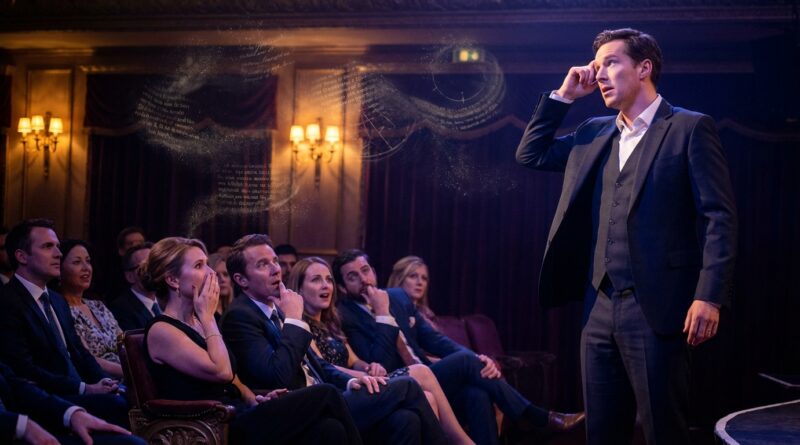
Inside The New ‘Review‑Proof’ Mentalist: Why Alex McAleer’s Mind‑Reading Shows Are Becoming 2026’s Quiet Obsession
If you have read one glowing mentalist review, you have probably read fifty. Five stars. “Unbelievable.” “Mind-blowing.” “Best night ever.” That kind of praise is not useless, but it does stop helping after a while. Fans want more than poster-size hype. They want to know what a performer actually feels like in the room. That is where the chatter around Alex McAleer mentalist reviews 2026 gets interesting. McAleer is becoming a quiet obsession not because he is the loudest name, but because people keep describing the same thing in different words. The show feels personal. It feels risky. It feels funny without turning into a stand-up set. And most of all, it feels hard to reduce to a neat star rating. That is usually the sign that something real is happening. When audiences struggle to summarize a show, it often means the performance did not just impress them. It got under their skin a little.
⚡ In a Hurry? Key Takeaways
- Alex McAleer stands out in 2026 because his shows feel genuinely interactive, tense and personal, not just polished.
- Before booking any mentalist, look past star ratings and ask how much real audience involvement, humor and unpredictability the show includes.
- The safest way to judge value is to read for specifics, not hype. Reviews that describe moments, reactions and pacing tell you far more than generic praise.
Why “review-proof” is suddenly a compliment
Usually, being hard to review sounds like a problem. For a mentalist, it can be the opposite.
When people call a show “review-proof,” they usually mean the usual review language does not quite fit. The old shortcuts break down. You cannot just say the tricks were slick, the theater was packed and the audience loved it. That covers thousands of shows.
What fans seem to be picking up on with McAleer is something more specific. His work sits in a sweet spot between psychology demo, comedy performance and social experiment. That mix gives people a harder job after the lights come up. They are not just asking, “Was he good?” They are asking, “How did that feel so personal when I was only watching?”
That is why Alex McAleer mentalist reviews 2026 matter more as a pattern than as a score. The details are where the real story is.
What makes Alex McAleer feel different in the room
He uses psychology as theater, not just as branding
A lot of modern mentalists talk about psychology. Some use it as atmosphere. Some use it as a clever sales line. McAleer’s appeal seems to come from making it part of the experience itself.
The audience is not simply told he understands influence, suggestion or decision-making. They feel those ideas working around them. That changes the tone of the room. Instead of a simple “watch me fool you” setup, the show becomes a live test of how people think, choose and react.
For non-techies, the best comparison is this. Think about the difference between a phone with a long spec sheet and a phone that just feels right in your hand. One sounds good on paper. The other works on a human level. McAleer appears to land in the second category.
He keeps the comedy useful
Funny mentalists are not rare. Funny mentalists who use humor to build tension are rarer.
That is an important difference. In weaker shows, jokes act like filler between reveals. In stronger ones, comedy relaxes the audience just enough that the next impossible moment hits harder. People laugh, let their guard down, then suddenly find themselves leaning forward.
That rhythm matters. It stops the show from becoming stiff or self-serious. It also stops it from turning into a novelty act. The humor gives people room to breathe. The mind-reading gives them a reason to gasp.
He puts real people at real risk
This may be the biggest point of all.
Some performers say a show is interactive when what they really mean is someone gets called on stage for two minutes and smiles for a photo. That is not the same as meaningful involvement.
The stronger comments around McAleer suggest a higher-stakes kind of participation. Audience members are not just decorations. Their choices matter. Their reactions shape the moment. And because there seems to be a real sense of uncertainty, the tension feels earned instead of staged.
For viewers, that raises the value of the whole night. If the show can genuinely wobble a little depending on who is in the room, then no two performances feel fully copy-paste. That is a big reason people talk about it differently afterward.
Why standard five-star reviews are failing fans
The problem is not that positive reviews are fake. It is that they are often too broad to be useful.
If every top mentalist gets called “amazing,” “unmissable” and “unreal,” then those words stop helping people choose. Fans end up buying tickets based on branding, venue size or social media clips, then hoping the live experience feels special.
That is why readers searching Alex McAleer mentalist reviews 2026 are often looking for something more grounded. They want clues. Was the audience deeply involved? Did the humor feel natural? Did the performer seem in control without feeling robotic? Did the surprises feel bigger because the setup felt human?
Those are the questions that separate a memorable show from a merely successful one.
How to read a mentalist review like a smarter buyer
Look for verbs, not adjectives
“Brilliant” tells you almost nothing. “He had three audience members making free choices while the whole room went quiet” tells you a lot.
The best reviews describe what happened and how it changed the room. If a review is full of vague praise and light on detail, treat it as background noise.
Check whether the audience sounds active
Good signs include phrases about participation, decision-making, tension, laughter, surprise and personal connection.
Bad signs include reviews that talk only about the performer’s charisma, costume, fame or headshots. Those things can help sell a ticket, but they do not tell you much about the show itself.
Notice whether the reviewer talks about atmosphere
People remember atmosphere when a show really lands. They mention silence before a reveal. They mention the room changing. They mention feeling nervous for the volunteer. Those details are gold.
When audiences write like that, they are usually reacting to an experience, not just rewarding a brand.
What this says about where mentalism is heading in 2026
The rise of quieter, more specific praise tells us something useful. Fans are getting pickier, and that is healthy.
They do not just want bigger effects. They want texture. They want performances that feel less manufactured. They want a mentalist who can handle psychology, crowd work, timing and uncertainty all at once.
That is partly because audiences are savvier now. They have seen slick clips online. They know what dramatic editing can do. A live performer has to offer something video cannot. Presence. Risk. Human weirdness. A feeling that what just happened belonged to that room and that night.
McAleer’s growing reputation seems tied to that shift. He is being talked about less like a product and more like an experience people are trying to explain to each other.
Questions to ask before you book any modern mentalist
If you want to use this as a benchmark, here are smarter questions to ask before spending money.
How much of the show depends on the audience?
If the answer is “quite a lot,” that is usually promising. It suggests flexibility, confidence and a less canned experience.
Is the humor part of the engine or just decoration?
A great show uses comedy to shape pacing and tension. It is not there just to fill dead air.
Do reviews mention specific moments?
If they do, you are likely reading real reactions. If they all sound the same, be careful.
Does the performer feel intimate or only impressive?
Impressive gets applause. Intimate gets remembered.
At a Glance: Comparison
| Feature/Aspect | Details | Verdict |
|---|---|---|
| Audience involvement | McAleer’s appeal appears tied to real participation and meaningful choices, not token volunteers. | Strong differentiator |
| Style and tone | Blends psychology and comedy in a way that keeps the show warm, tense and accessible. | Feels modern and human |
| Review quality | Best signals come from detailed reactions and described moments, not generic five-star praise. | Use specifics as your buying guide |
Conclusion
If you are tired of scrolling through identical praise and trying to guess which mentalist is actually worth your night, Alex McAleer offers a useful benchmark. The point is not just that people like the show. Plenty of performers get liked. The point is that people seem to describe his work with more detail, more tension and more personal reaction. That gives the Best Mentalist community something better than another stack of star ratings. It gives them a concrete standard. Look for the mix of psychology, comedy and real audience stakes. Look for reviews that describe moments, not marketing lines. Do that, and you will choose better shows, ask smarter questions before you book and take part in the bigger conversation about what modern mind-reading should feel like in 2026.